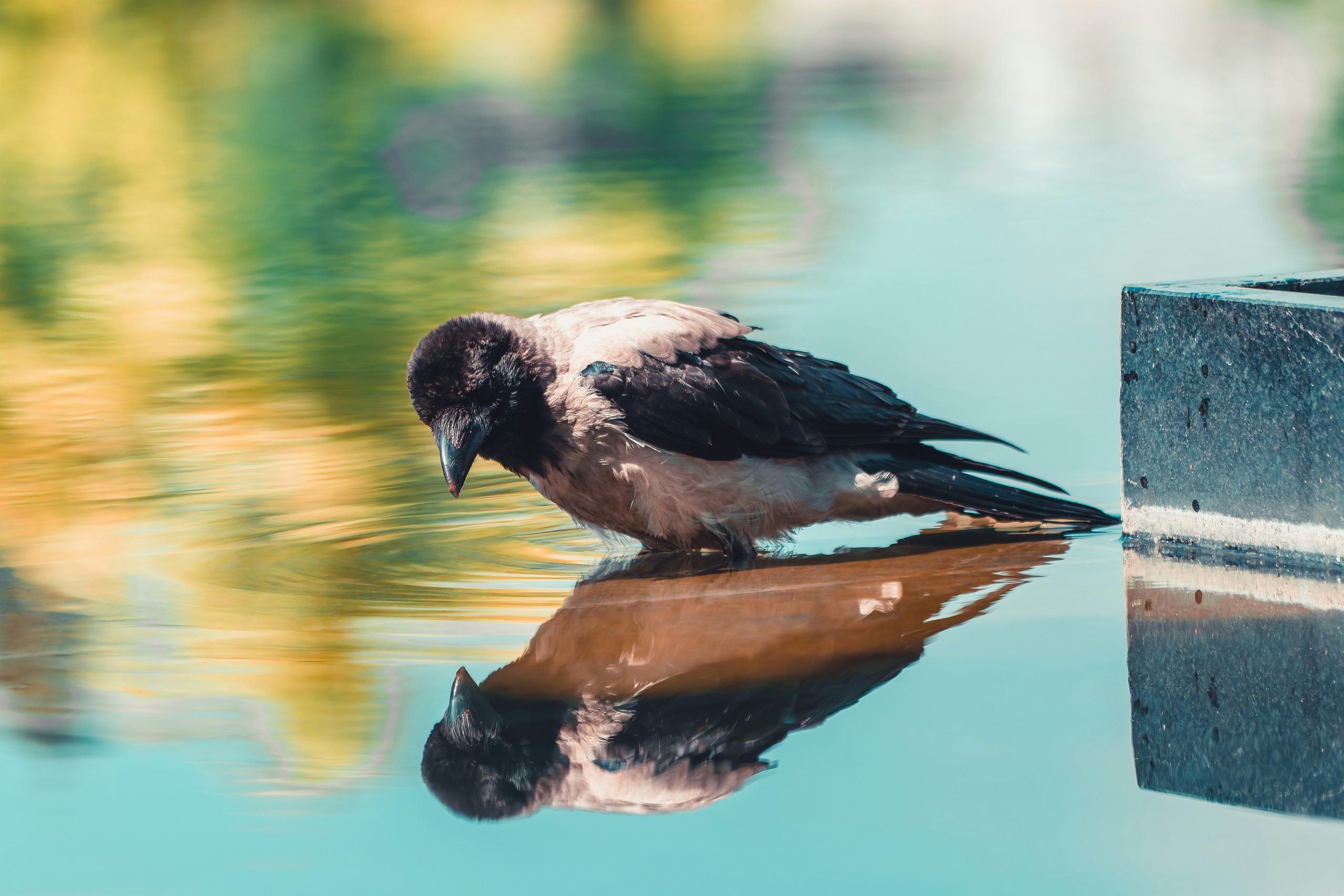
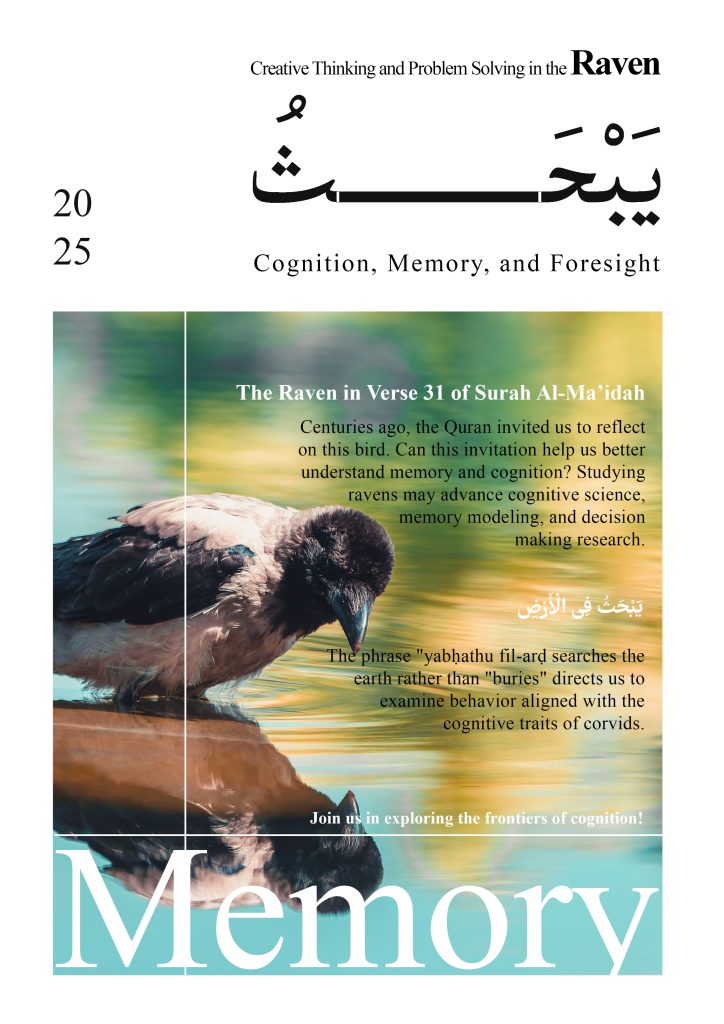
Corvids (the crow family) are among the most intelligent creatures on Earth. Recent research has demonstrated their exceptional memory, capacity for future planning, and even signs of understanding others’ intentions. These traits raise fascinating questions about the relationship between memory, creativity, and problem-solving—topics of significance across cognitive science, biology, behavioral psychology, and even artificial intelligence.
This call invites enthusiasts at all levels of science and art to contribute their understanding of corvid behavior through diverse scientific, experimental, and artistic formats. Below are suggested ideas tailored to participants’ ages and academic levels, though we welcome all worthy scientific, artistic, or literary contributions. A university professor might design an outstanding research poster, while an elementary student could propose a valuable hypothesis based on observing crows.
These studies will be pursued at various levels (student, undergraduate, graduate, and professional research) through schools, research centers, universities, and our dedicated website.
Level 1: Elementary Students | Introduction to Corvids and Basic Cognitive Concepts
Suggested Activities:
- Poster Design: How do crows store their food?
- Storytelling: If you were a crow, how would you hide your food?
- Observation & Videography: Recording crow behavior in parks, schoolyards, or nature.
- Crafts & Drawings: Depicting a crow planning its food storage.
Goal: Foster interest and awareness about avian intelligence and basic corvid behavior.
Level 2: Middle/High School Students | Scientific Analysis of Corvid Behavior in Nature and Culture
Suggested Research Topics:
- Behavioral Study: How do different corvids (rooks, ravens, etc.) use memory to locate food?
- Literary Analysis: Is the fable The Fox and the Crow scientifically accurate? Do crows employ complex strategies to prevent food theft?
- Introducing the Pica (Iranian Ground Jay): The only corvid native to Iran—compare its cognitive traits with other crows.
Goal: Students gain deeper insight into corvid behavior while exploring connections between science, literature, and culture.
Level 3: Undergraduate Students | Designing Experiments and Analyzing Corvid Cognition
Proposed Research Questions:
- Decision-Making: How do crows evaluate valuable resources? Do they hoard, consume, or even “gift” them?
- Theory of Mind: Can corvids infer others’ intentions and adjust their behavior accordingly?
- Cognitive Testing: How can we design valid experiments to assess crows’ planning and decision-making abilities?
Goal: Students develop a scientific understanding of corvid cognition through empirical research and data analysis.
Level 4: Graduate Students (Masters/PhD) | Advanced Studies on Corvid Memory and Cognition
Proposed Research:
- Neural Mechanisms: Which brain regions support memory and information processing in corvids?
- Memory Systems Comparison: How do episodic, semantic, and working memory influence decision-making?
- AI Modeling: Can corvid cognition inspire machine learning architectures?
Goal: Investigate the parallels between corvid and human cognition, with applications to computational models.
Level 5: Researchers (Interdisciplinary Studies & Cognitive Modeling)
Key Themes:
- Executive brain functions in corvids and their link to creativity/problem-solving.
- Modeling dominant memory systems in corvid decision-making.
- Machine learning applications to simulate corvid information storage/retrieval.
- Social dynamics and collective intelligence in corvid groups.
Goal: Advance interdisciplinary research in cognitive science, biology, and AI by decoding corvid intelligence.
Submission Guidelines
All participants—regardless of academic level—may submit findings as research papers, posters, videos, stories, or other creative formats.
- Outstanding contributions will be published on the project’s official website.
- Scientific awards will honor top research.
- No restrictions on presentation methods: a child’s inspired idea is as welcome as a professor’s artwork.
Submit via the project website.
Why This Research Matters
Corvid memory, cognition, and problem-solving open new windows into animal intelligence and machine learning.
- Studying these birds may advance cognitive science, memory modeling, and decision-making theories.
- Centuries ago, the Quran invited reflection on the crow’s wisdom. Can this ancient insight deepen our modern understanding of cognition?
We await your innovative research, ideas, and creations!