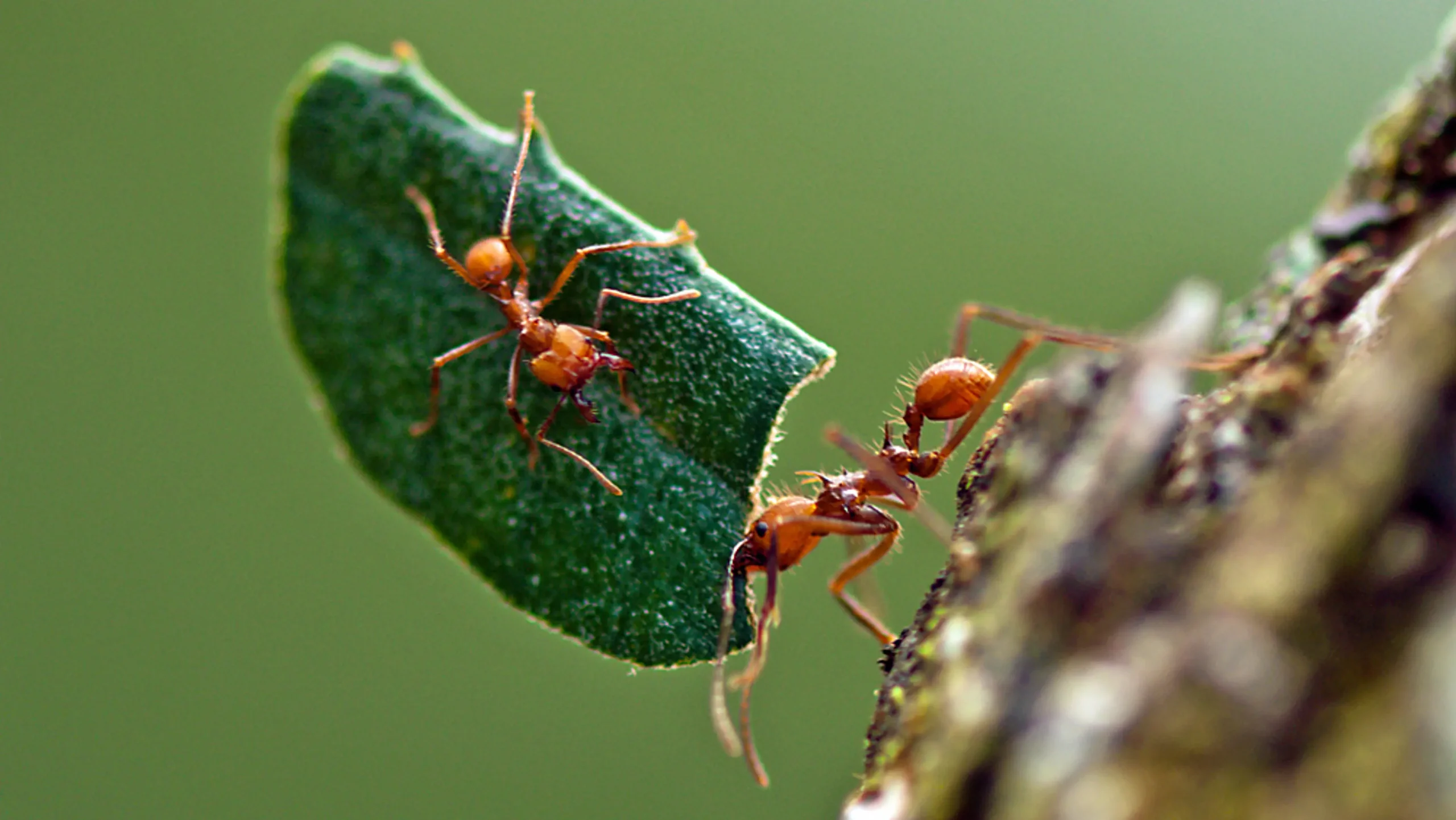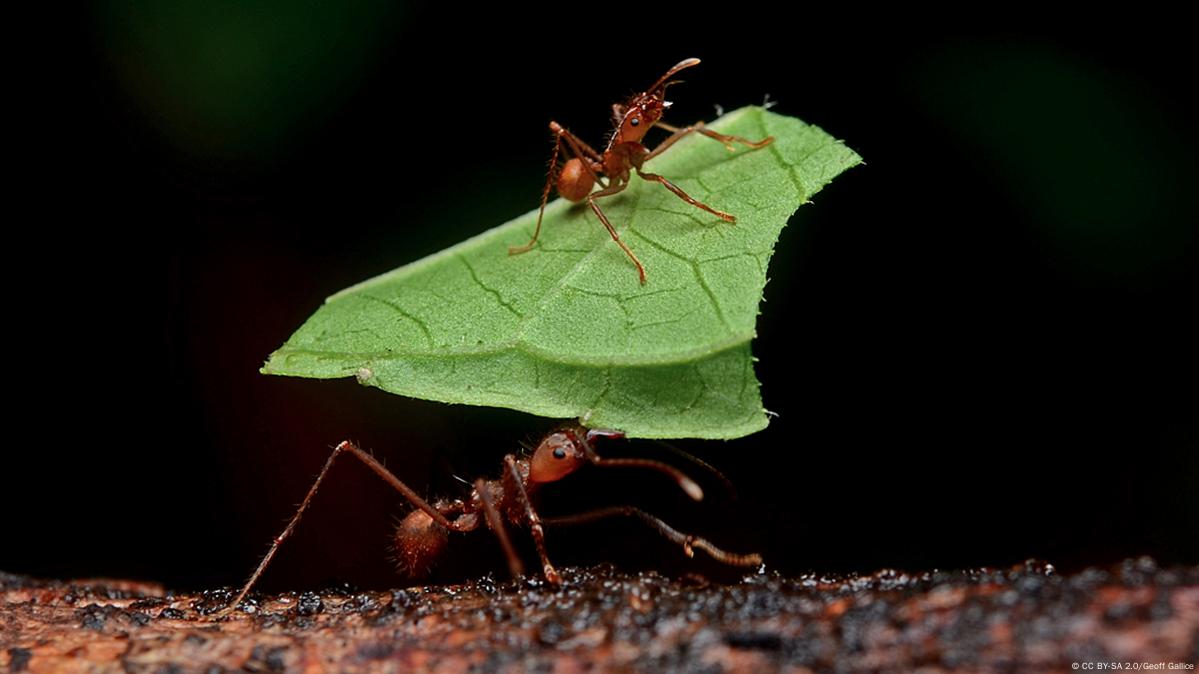
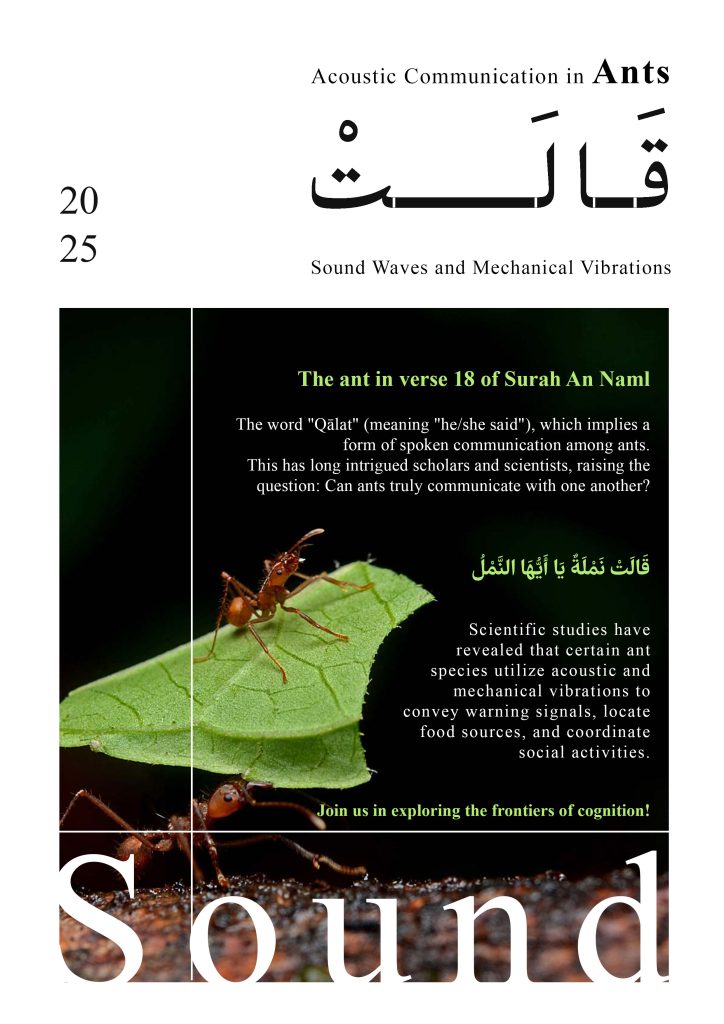
Research has demonstrated that certain ant species utilize acoustic and mechanical vibrations to convey warning signals, locate food sources, and coordinate social behavior.
Three primary sound production mechanisms in ants:
- Stridulation: Sound generation through friction between two specialized organs (a scraper and file)
- Drumming: Striking various surfaces using specific body parts to create vibrations
- Crepitation: Rapid mandible movement and scraping of the lower jaw against surfaces, producing chirp-like sounds
Specialized sound reception organs in ants include:
- Johnston’s organ: Located in antennae, believed to detect airborne sounds
- Subgenual organ: Responsible for perceiving substrate-borne vibrations
These findings indicate that ants not only possess sound production capabilities but also have sophisticated systems for receiving and processing acoustic signals.
Research Call: Scientific and Technological Investigation of Ant Acoustic Communication Inspired by the Quran
Recent studies have revealed that ants employ complex communication methods, including the production and reception of acoustic waves. In this context, verse 18 of Surah An-Naml introduces the term “qālat” (she said), which appears to reference a form of acoustic communication among ants. The scientific question of whether ants can truly produce and perceive sound is now being investigated using advanced tools such as microscopic imaging, audio signal processing, and behavioral analysis.
This call invites researchers, students, and interested scholars to participate in the scientific and engineering investigation of this remarkable phenomenon and explore its potential applications in modern technologies.
Level 1: Elementary Students | Introduction to Ants and Basic Communication Concepts
Suggested activities:
- Poster design: How do ants “talk” to each other?
- Creative writing: If you were an ant, how would you warn your friends?
- Arts and crafts: Depicting ants using different communication methods
- Observation and videography: Recording ant behavior in natural environments
Objective: Cultivating interest and basic awareness about insect intelligence and ant communication systems.
Level 2: Secondary Students (10-18 years) | Preliminary Observations and Experiments on Ant Communication
Suggested activities:
- Behavioral recording: Documenting potential sound-related movements
- Audio recording: Attempting to capture ant-produced sounds using sensitive microphones
- Sound simulation: Recreating ant-like sounds using simple tools
- Response testing: Observing ant reactions to various sound frequencies
Research questions:
- Can indirect methods (e.g., vibration detection) be used to study ant sounds?
- Does altering comb tooth spacing produce different ant-like sounds?
- Do certain ant species rely more heavily on acoustic communication?
Objective: Encouraging scientific thinking through simple yet meaningful biological experiments.
Level 3: Undergraduate Students and Independent Researchers | Experimental Studies on Ant Acoustic Communication
Suggested research topics:
- Comparative analysis of sound production/reception across ant species
- Audio data collection and processing using specialized software
- Controlled experiments on ant responses to airborne/substrate vibrations
- Environmental impact studies (temperature, humidity, substrate type)
Recommended tools: Ultrasonic microphones, audio processing software, behavioral labs.
Objective: Advancing practical understanding of ant communication systems.
Level 4: Graduate Students (Masters/PhD) | Advanced Research in Ant Biomechanics and Behavior
Suggested research topics:
- Microscopic imaging of ant sound organs (SEM/TEM)
- Computational modeling of ant sound production mechanisms
- Comparative analysis of airborne vs. substrate-borne communication
- Social behavior studies related to acoustic signaling
Objective: Conducting precision research using modern technologies to understand ant bioacoustics.
Level 5: Interdisciplinary Researchers | Bio-inspired Technological Applications
Suggested research areas:
- AI algorithms inspired by ant communication networks
- Biomimetic designs for wireless communication systems
- Swarm robotics applications
- Comparative analysis of Imam Reza’s (AS) hadith with modern acoustics
- Medical/industrial applications of ant-inspired ultrasonic technology
Submission Guidelines:
Accepted formats: Research papers, scientific posters, videos, software, simulations
Outstanding work will be featured on the project website with award opportunities
Interdisciplinary collaborations are encouraged
We anticipate your innovative contributions!