Feasibility Study and Simulation-Based Evaluation of Ummah Formation Using Complex Systems Science Tools
Understanding and representing the ideal Quranic system—or the valayah-based society, which has been the ultimate goal of all prophets and infallible Imams (peace be upon them)—is the most critical knowledge for Muslim scholars and thinkers."
This research boldly transcends disciplinary boundaries, merging cutting-edge tools from complex systems science to present a novel framework for understanding Quranic societal structures. By integrating computational modeling with Quranic semantic analysis, the authors demonstrate how valayah (divine guardianship) and brotherhood (ukhuwwah) can foster the emergence of a 'middle ummah' (Ummatun Wasat). This study not only marks a significant advancement in interdisciplinary research bridging Islamic studies and social sciences but also illuminates a path for scholars seeking to redefine religious concepts within contemporary scientific paradigms."
Abstract
Social life and the essence of collective spirituality are among the Quran’s most fundamental teachings. The prophets and infallible Imams (peace be upon them) endeavored to transform non-tawhidi (non-monotheistic) social structures into an ideal Islamic framework—the unified ummah (Ummah Wahidah) and the “paradise of valayah”—through strategic interventions, foremost among them being valayah (divine guardianship), shaping a balanced structure termed the “middle ummah” (Ummatun Wasat). Unfortunately, no comprehensive study has yet adequately represented the Quranic perspective on societal structures or modeled their evolution. This research aims to address this gap by employing tools from the emerging field of complex systems science—specifically, network theory and agent-based modeling—to visualize the Quranic societal structure, particularly the “middle ummah,” and elucidate its formation and dynamic evolution.
The Quran portrays humans as inherently social beings. Social life and the cultivation of collective spirituality are among its most fundamental teachings. This Quranic depiction far transcends conventional views that reduce social life to a means of fulfilling individual needs—where humans resort to communal living merely due to growing needs and their inability to satisfy them independently. In contrast, the Quran presents social life as a continuum from creation to the Day of Judgment, anchored in the key concepts of valayah (divine guardianship) and collective will, ultimately culminating in the formation of a valayah-based society and the realization of paradise. From this perspective, understanding and representing the ideal Quranic system—or the valayah-centric society, which all prophets and infallible Imams (peace be upon them) sought to establish—along with its mechanisms and pathways for optimal realization, constitutes the foremost intellectual pursuit for Muslim scholars.
Identifying the nature of social structures and their reorganization for enhanced functionality has long been a central concern in the humanities, particularly sociology and economics. Advances in systems science and the emergence of complex systems theory—now recognized as the framework for most advanced biological and human structures—coupled with exponential growth in computational power, the internet, virtual social networks, and human-monitoring tools, have enabled empirical representation, analysis, and simulation of social structures. Social scientists leverage vast datasets from global internet and mobile networks to reconstruct and analyze social networks as intricate graphs, examining their topology and dynamics to uncover laws governing collective behavior. By modeling social interactions, they can now simulate macro-level societal dynamics emerging from micro-level interactions. These capabilities have propelled “social engineering,” bringing the prospect of an optimally functional society closer than ever. Yet, such interdisciplinary technologies also risk being co-opted by power structures to manipulate societies toward politically or economically expedient dynamics. Consequently, universities and specialized research centers in social physics and complex systems have emerged as pivotal actors in this domain.
This study employs agent-based simulation, a tool from complex systems physics, to partially model the Quranic concept of ummah (community) based on valayah-centric relationships. Like all models, this simulation simplifies reality, offering a limited reflection. Beyond assessing the feasibility of such tools for representing Islamic social concepts, this research critically examines their limitations and proposes potential improvements.
The core research questions are:
What are the social structures described in the Quran, and how do they emerge?
Can a simplified computational model represent these structures and their dynamics? What are its features?
How can simulation outcomes be evaluated? Do they validate the use of such tools for Islamic social concepts?
What limitations does this model entail?
The study’s outputs include:
Representation of Quranic social structures.
A proposed complex-systems model for these structures.
Simulations of Quranic social dynamics within the constraints of current tools.
This interdisciplinary work bridges Quranic studies (focusing on terms like valayah and ummah—including Ummah Wahidah, Ummah Muslimah, Ummah Muqtasidah, and Ummatun Wasat) and complex systems physics. Notably, the topic remains unexplored in academia, positioning this research as both novel and pioneering. Given the cutting-edge state of social network theory and its synergy with complex systems, this study could advance global academic engagement with the Quran’s social vision.
2. Literature Review
The study of human societal structures and their dynamics is arguably the paramount concern of knowledge, as all scientific endeavors ultimately aim to shape an ideal society. This aligns with the mission of prophets and Imams (peace be upon them), whose vision of an ideal society is rooted in divine principles. Scholars like Shahid Sadr frame the “social question” as humanity’s failure to discern the optimal system (a societal framework ensuring collective felicity) (Kalantari & Mahdizadeh, 2012).
In sociology, defining an ideal society and identifying the laws—whether ontological or legislative—that predict or steer societal dynamics remain contested. Even the term “society” lacks consensus (Saroukhani, 1996). Its ambiguity has led to conflation with terms like nation, ummah, and civilization, while some scholars restrict it to large-scale, organically integrated groups, labeling smaller collectives as “tribes” or “bands” (King, 1976).
Definitions vary by ideological school: some emphasize shared utilitarian goals (Saliba, 1991), others highlight traditions, rituals, or cultural cohesion (Biro, 1987), and still others focus on territorial, political, or moral unity (Sauvy, 1979; Gould & Kolb, 1997). Morteza Motahhari (1998) defines society as humans bound by shared needs, beliefs, and ideals, while Saliba (1991) stresses stable, reciprocal relationships under common objectives.
In contrast, social physicists adopt a pragmatic approach, using computational tools and virtual platforms to model social structures and dynamics (Pentland, 2014). Section 4.2 will exemplify this methodology.
3. Research Methodology
The research methodology encompasses three domains: religious/Quranic research, scientific research, and the integration of these two approaches, as follows:
3.1. Religious and Quranic Research Methodology
In examining vocabulary related to societal structures, various Quranic semantic approaches can be employed. Semantic analysis is primarily conducted through two approaches:
Descriptive semantics operates at two interrelated linguistic levels:
Lexical Level: Identifies the fundamental and contextual meaning of a word in isolation, independent of any descriptive, referential, or textual associations.
Sentential/Discursive Level: Seeks the relative meaning of a word within the Quranic text.
Various semantic theories—such as referential/conceptual theory, behaviorist theory, contextual theory, semantic field theory, and analytical theory—can be categorized under these two levels (Ahmed Mokhtar Omar, 2006).
In this study, the following Quranic semantic approaches are adopted:
Lexical Semantics: A descriptive (synchronic) method at the word level, based on referential/conceptual theory.
Semantic Network Theory: A descriptive (synchronic) method at the discourse level.
Contextual Semantics: A descriptive (synchronic) method at the sentence/context level (where necessary).
Etymology: A historical (diachronic) method, emphasizing theolinguistics and the unified origin of languages.
3.2. Scientific Research Methodology
Since human social structures are recognized as complex systems, this study employs complex systems physics to model societal structures and their dynamics. The scientific methodology consists of two components:
Identifying Representation Methods: Examining how human and animal complex social systems are modeled.
Agent-Based Simulation: Introducing this as an effective approach for studying complex system dynamics.
3.3. Integrative Methodology: Bridging Religious/Quranic and Scientific Research
The integration of scientific and Quranic research involves:
Structural Modeling: Borrowing tools from complex systems representation to construct a Quranic societal model based on the semantic analysis of Quranic terms related to community.
Dynamical Simulation: Using agent-based modeling to simulate the dynamics of a Quranically defined society (or a subset thereof) as a complex system.
4. Results and Discussion
4.1. Social Complex Systems
A complex system refers to a collection of numerous interacting components whose collective behavior cannot be predicted from the behavior of individual parts alone. This means that in complex systems, the whole is significantly greater than the sum of its parts, exhibiting emergent and unpredictable behaviors.
Due to interactions between components and feedback loops, the overall behavior of complex systems is often nonlinear. Many complex systems possess self-organizing capabilities, meaning they can form intricate structures and patterns without external intervention. Emergence is a hallmark feature of complex systems—these behaviors manifest at the macro level and are not deducible from micro-level interactions. Complex systems are sensitive to initial conditions; minor changes can lead to significant, unpredictable long-term behavioral shifts.
Examples of complex systems include:
Biological systems: Human brains, ecosystems, and cells.
Social systems: Human societies, financial markets, the internet, and virtual social networks.
Physical systems: Weather patterns and urban traffic.
To represent complex system structures, network theory (and occasionally fractal geometry) is employed. Dynamics are modeled through computational simulations, with agent-based modeling being particularly suited for capturing emergent behaviors (Ahmadi, 2022).
4.1.1. Structural Typologies of Social Complex Systems
Complex systems are represented as networks comprising nodes (components) connected by edges (interactions). Network topology varies based on connection patterns:
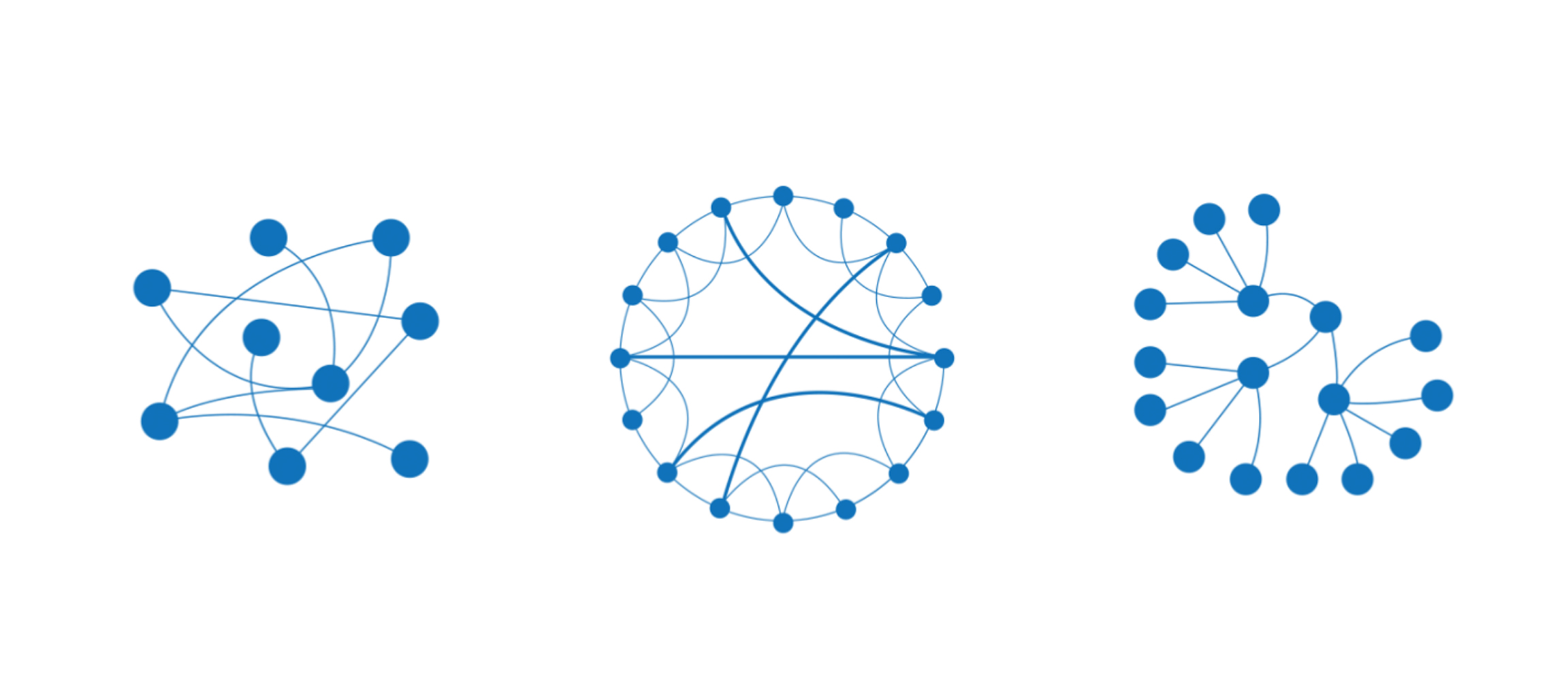
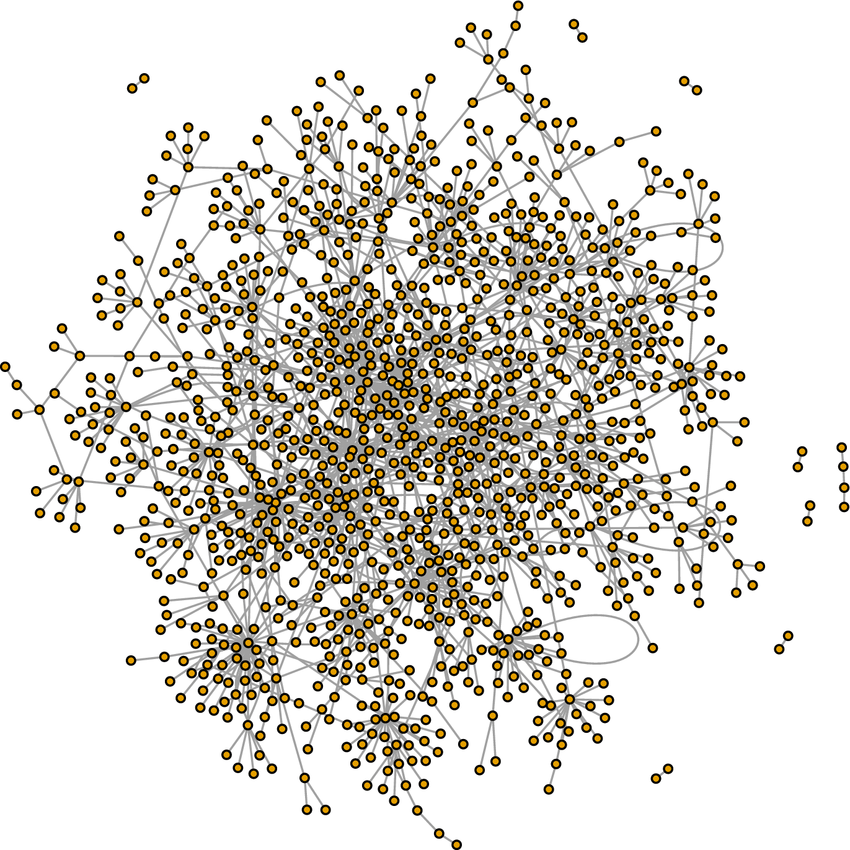
Most real-world complex systems, however, exhibit either small-world or scale-free architectures (Figure 1), or hybrid forms:
Small-world networks: Characterized by short path lengths and high clustering, enabling efficient information transfer. Examples include primate social groups (e.g., monkeys, dolphins), neural networks, and power grids. These networks excel in rapid coordination and collective problem-solving.
Scale-free networks: Feature a few highly connected hubs alongside many sparsely connected nodes. Observed in eusocial insects (e.g., ants, bees) and human systems like the internet. Their resilience stems from hub-mediated stability (Meyers, 2009).
(b) Random (a) Small-world (c) Scale-free Figure 1. Common complex network architectures
4.1.2. Dynamics of Social Complex Systems
Agent-based modeling simulates structural evolution in social networks by treating individuals as autonomous agents with distinct traits and behavioral rules. Simple interaction rules can generate emergent hierarchies or collective states. This approach is used to:
Simulate social group formation based on shared traits.
Model leadership emergence through defined selection mechanisms.
4.2. Case Studies of Social Complex Systems
4.2.1. Animal Social Structures
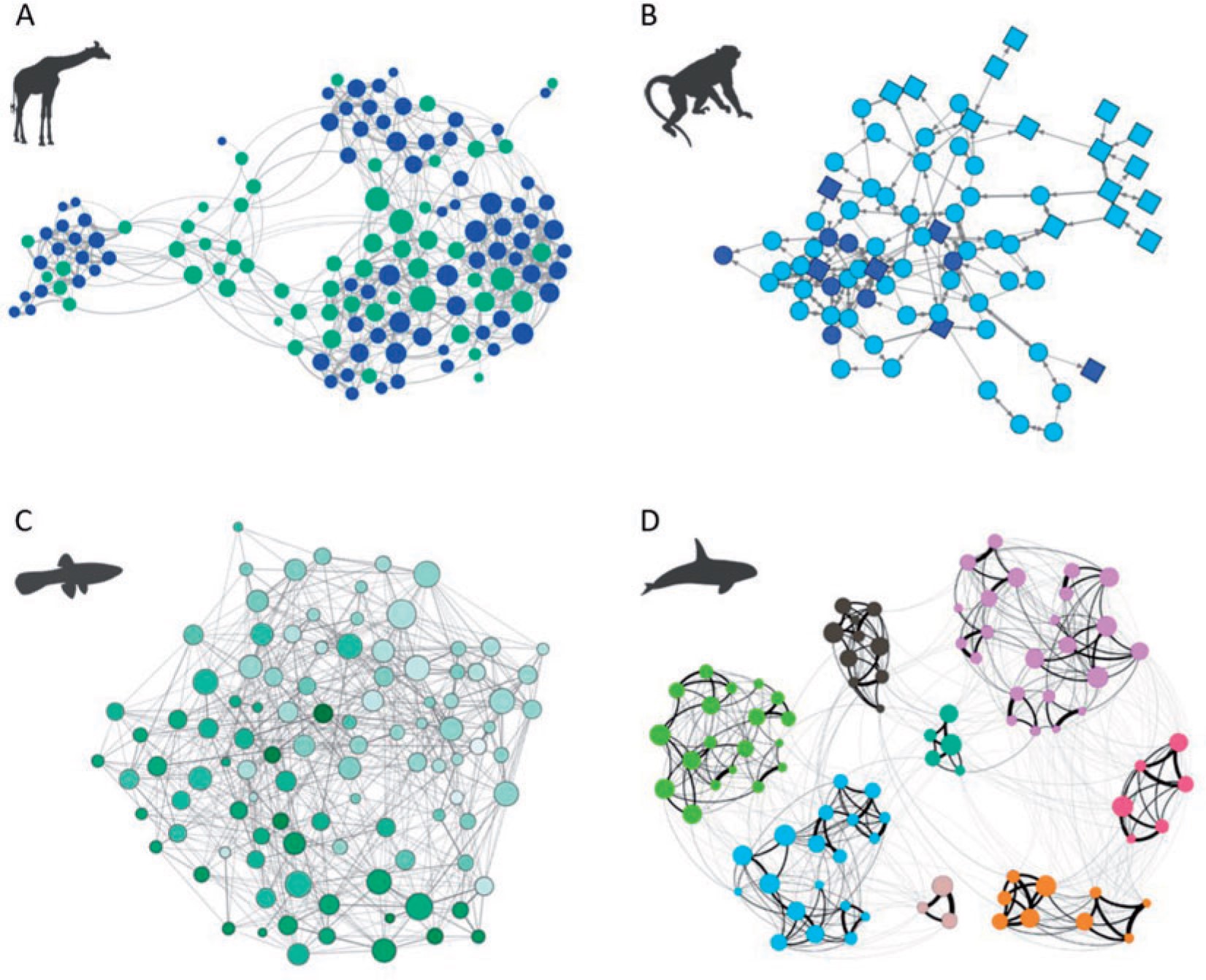
The Quran designates animal collectives as ummam (communities). Studies reveal that animal interaction networks are non-random, typically exhibiting small-world or scale-free properties (Figure 2). Evolutionary processes drive hierarchical or modular clustering:
(Figure 2).Evolutionary processes drive hierarchical or modular clustering
Hierarchical structures: Dominance hierarchies, as seen in macaque troops, where kinship and seniority dictate social rank.
Modular structures: Functional subgroups (e.g., task-specific roles in meerkat colonies).
Two theories explain cooperative dynamics:
Kin selection: Altruism toward genetic relatives enhances shared gene survival (e.g., worker bees aiding the queen).
Reciprocal altruism: Mutual aid among non-kin, sustained by repeated interactions and cheat detection (e.g., vampire bats sharing blood).
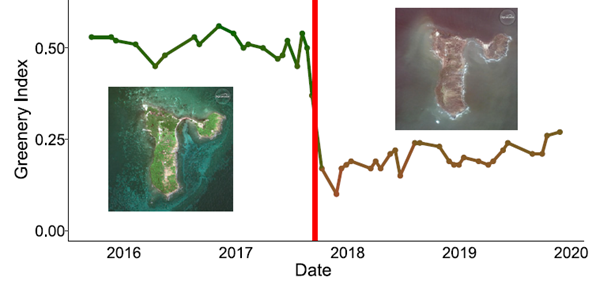
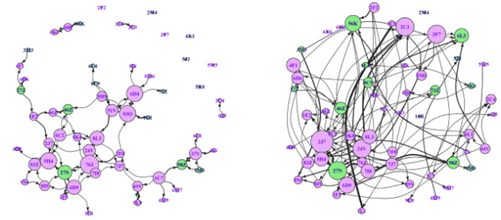
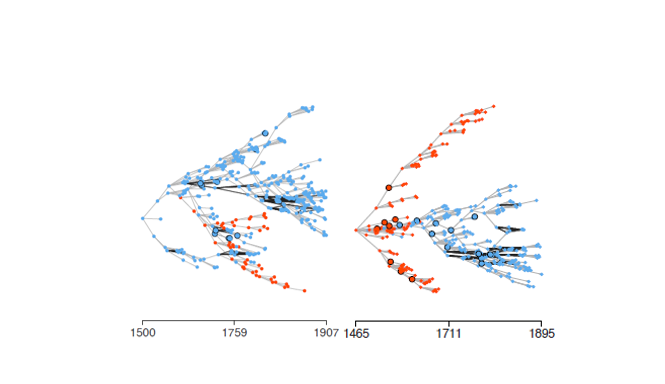
Notably, societies often transition from kin-based to reciprocal cooperation, especially under resource scarcity (Figure 3). Post-hurricane shifts in macaque grooming networks (Testard et al., 2021) exemplify this.
Figure 4. Affinal ties among Taiwanese clansFigure 5. Consanguineous ties in Swiss dynasties
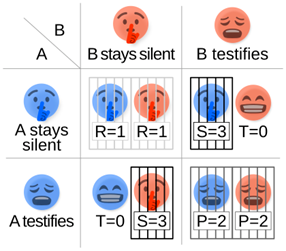
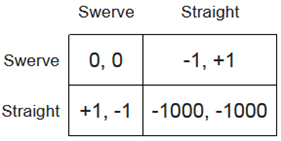
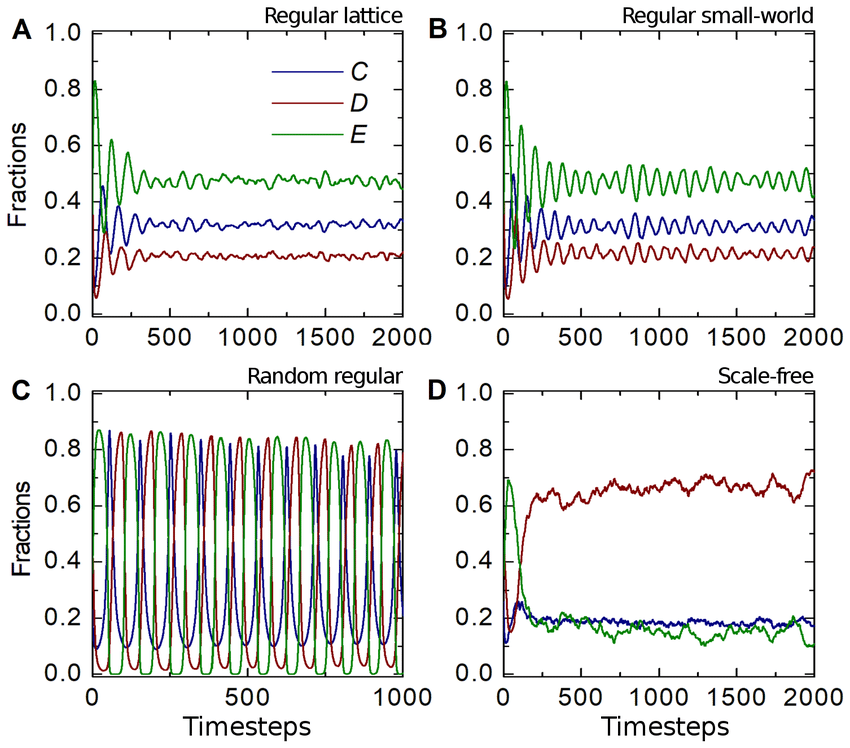
Cooperation dynamics: Simulated via game theory, where agents adopt strategies (Cooperate [C], Defect [D], or Withdraw [E]). Payoff matrices (Figure 6) define outcomes:
Prisoner’s Dilemma: T > R > P > S.
Chicken Game: R > P; S > T.
define outcomes(Figure 6)
Network evolution rules include:
Strategy updates: Agents mimic successful neighbors or reinforce past rewards.
Topology updates: Link formation/severance over time.
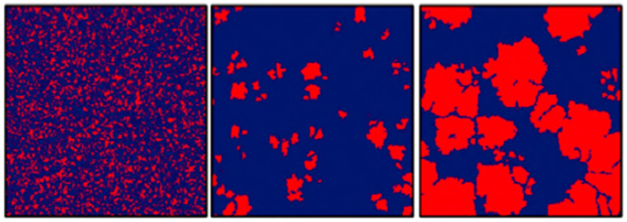
Scale-free networks inherently favor defection (Figure 7), while cooperation clusters emerge in structured interactions (Figure 8) (Jusup et al., 2022).
Figure 7. Cooperation dynamics across network typesFigure 8. Spatiotemporal formation of cooperative clusters
4.3. Social Structures from the Quranic Perspective
This section aims to compile and semantically analyze Quranic terms related to society, ultimately presenting a graphical representation of Quranic social structures.
4.3.1. Semantic Analysis of Quranic Terms Denoting Society
While the Quran does not explicitly use the term “society” (مُجْتَمَع) in its conventional sense, it employs numerous social constructs and terms that fall under this concept, such as fīʾah (فئة), qarn (قرن), shuʿūb (شعوب), raht (رهط), ummah (أمة), awlīyāʾ (أولياء), ahl (أهل), ahl al-qurā (أهل القرى), qawm (قوم), ḥizb (حزب), ṭāʾifah (طائفة), and qabīlah (قبيلة). This suggests that Quranic social structures are inherently hierarchical and multi-layered (Fakhr Zareʿ, 2014).
Here, we focus on the term ummah (أمة), though other Quranic concepts also contribute to the proposed structural representation (their detailed analysis exceeds this paper’s scope).
Lexical and Etymological Analysis
From a referential-conceptual semantic approach, ummah derives from umm (أم), denoting a group united by common features—whether voluntary or imposed—such as shared religion, era, or locality (Rāghib al-Iṣfahānī, n.d., p. 86). The term appears 65 times in the Quran (52 singular, 13 plural), often referring to human collectives bound by faith, time, or space, pursuing a unified divine purpose (e.g., Q16:36; Q7:7; Q2:128, 134; Q5:48).
Etymologically, ummah shares roots with Arabic umm (mother), Persian mām/māmā (mother), and English mum/mother, all signifying “origin” or “source.” This underscores humanity’s shared origin despite racial/linguistic diversity. Notably, the Arabic amn (أمن, “security”) and Latin humanus (root of “human”) further emphasize universal humanism and tranquility. The semantic overlap between imām (leader) and ummah (community) is also striking. Thus, ummah (particularly Ummah Wāḥidah, the “unified community”) aligns with Humanity—a global collective transcending artificial boundaries (al-Ḥusaynī, 2007).
Contextual and Semantic Field Analysis
Broader contextual analysis reveals that ummah encompasses:
Animal collectives: “There is no creature on earth or bird flying with its wings but are communities (umam) like you…” (Q6:38).
Human groups rooted in disbelief: “We granted enjoyment to such umam [disbelieving nations], then a painful punishment seized them…” (Q11:48); “We sent messengers to umam before you, but Satan made their deeds appealing…” (Q16:63).
The term Humanity better corresponds to Ummah Wāḥidah (Q2:213), the primordial unified community before divisions arose from selfish desires.
Key Observations:
Ummah denotes both individuals and groups distinguished by adherence to a value system (e.g., Prophet Ibrāhīm as a one-man ummah due to his monotheistic separation; Q7:159).
Divine segmentation of communities (e.g., the Twelve Tribes of Israel; Q7:160) later evolved into righteous/corrupt factions (Q7:168).
Quranic classifications like Ummah Wāḥidah, Ummah Wasaṭ (moderate community), Ummah Muslimah (submissive community), and Ummah Muqtaṣidah (balanced community) reflect gradations in collective spiritual motion toward goodness.
4.3.2. Ontological Status of Ummah
A critical debate arises: Does an ummah possess an existence independent of its individuals? Scholars like Ayatollah Miṣbāḥ Yazdī reject this (Miṣbāḥ, 2001), while ʿAllāmah Ṭabāṭabāʾī argues for ummah‘s metaphysical reality based on Quranic attributes (e.g., collective lifespan, record, consciousness, obedience/rebellion; Ṭabāṭabāʾī, 1997, vol. 4, p. 96). Shahīd Ṣadr similarly affirms societal “laws of history” (Ṣadr, 1990).
4.3.3. Non-Quranic Islamic Perspectives
Prominent contemporary scholars (e.g., Ayatollah Shāhābādī, Ayatollah Khamenei, Shaykh Ṣafāʾī Ḥāʾirī) envision an ideal Islamic society (Ummah Wāḥidah) anchored in wilāyah (divine guardianship). Key tenets include:
Transition from materialistic to worship-centric lifestyles.
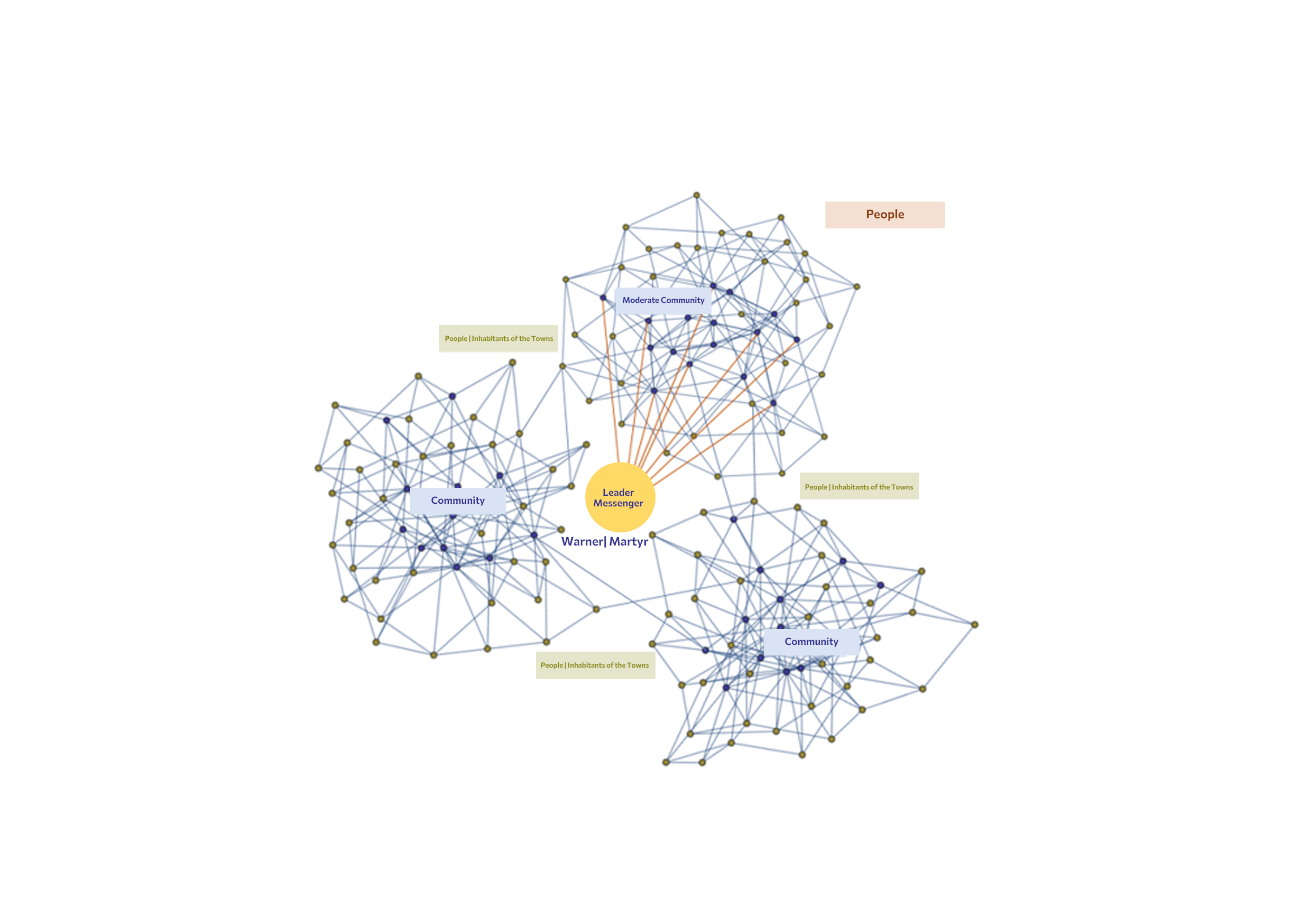
Formation of a vanguard Ummah Wasaṭ—a resilient network of believers leveraging kinship and strategic piety to establish divine governance.
Ultimate divine victory and global transformation heralding the Hereafter.
4.4. Dynamics of Ummah Formation
4.4.1. Agent-Based Model of Ummah
This model simulates agents with two strategies:
Brotherhood (ukhuwwah): Analogous to “cooperation,” drawing agents closer.
Estrangement (tafarruq): Analogous to “defection,” driving separation.
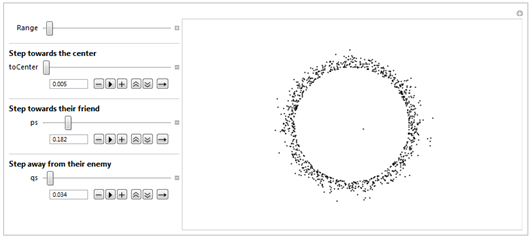
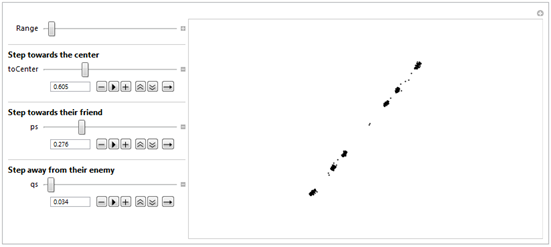
Unique to this simulation is centripetal motion—agents’ attraction to a central “Imam” figure, modeling wilāyah. Network updates occur via:
Dynamic topology: Random friend/foe reassignment.
Static topology (e.g., fixed kinship networks).
4.4.2. Simulation Results
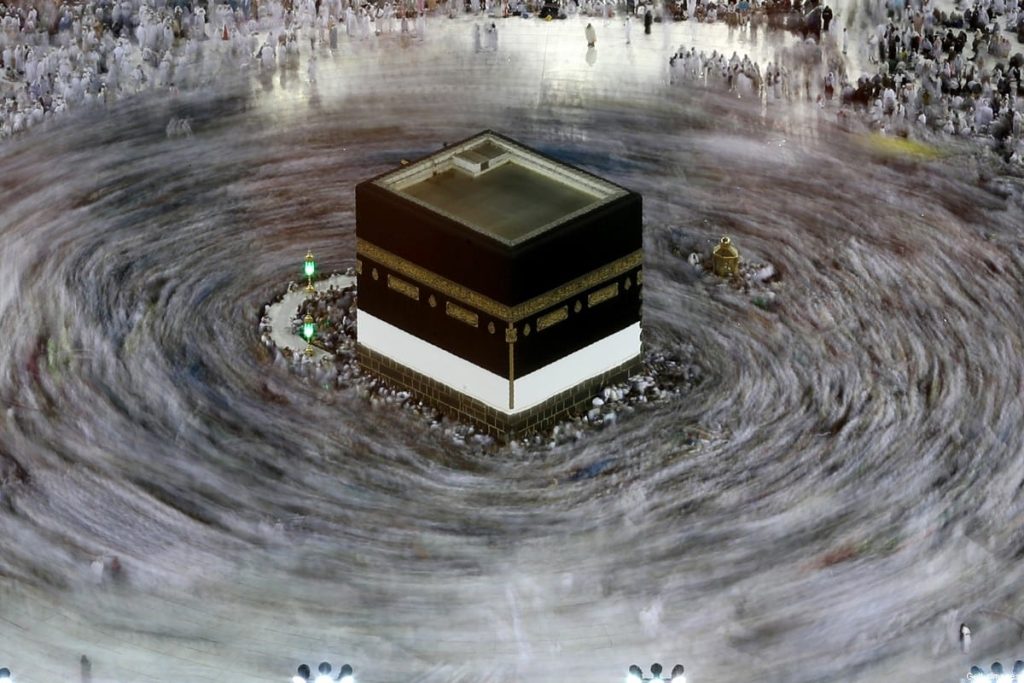
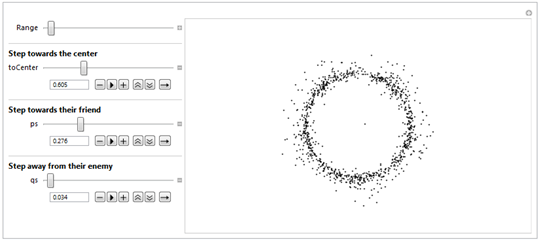
Circular Motion (Ṭawāf-like): Simultaneous centripetal (wilāyah) and interpersonal (ukhuwwah) motions generate concentric rotation (Figure 10), mirroring circumambulation of the Kaaba.
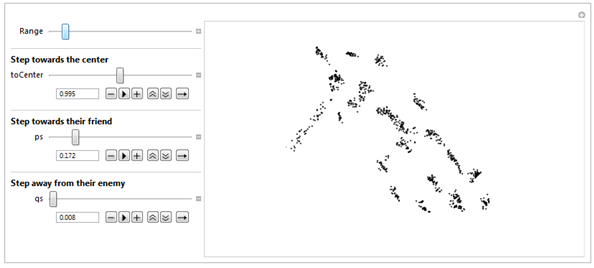
Fragmentation: Overemphasis on ukhuwwah without wilāyah leads to clustered divisions (Figure 11), echoing Q3:103 (“Hold fast to God’s rope collectively, and do not divide”).
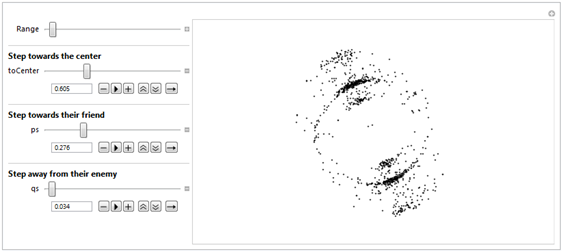
Majority-Minority Groups: Over time, one dominant group emerges alongside smaller factions with fluid membership (Figure 12).
Theological Implications: Validates Quranic prescriptions for communal cohesion through computational realism.
This work pioneers the application of agent-based modeling to Quranic social dynamics, offering a framework for future Islamic-computational interdisciplinary studies.
“This study demonstrates through agent-based simulation that simultaneous attention to the centrality of the Imam (leadership) and fraternal bonds among individuals creates a rotational structure akin to Tawaf around the Kaaba. Conversely, prioritizing individual relationships without the axis of wilayah (divine guardianship) leads to fragmentation and discord.”
5. Conclusion and Future Research Directions
This study has undertaken a semantic analysis of Quranic terminology related to societal structures, presenting a conceptual representation of the social frameworks described in the Holy Quran. Subsequently, we explored the formation and dynamics of the Ummah Wasaṭ (moderate community) by examining the intuitive relationship between the Messenger/Imam and the community, as well as the dual bonds of wilāyah (divine guardianship) connecting individuals to the Imam and ukhuwwah (brotherhood) uniting members of the ummah. Our findings reveal that the resulting structure exhibits a rotational pattern centered around a leadership axis, symbolically reminiscent of the ṭawāf (circumambulation) around the Kaaba. Additionally, the simulations demonstrated fragmentation scenarios arising from neglect of the Imam’s centrality, leading to divisive clustering within the community.
It must be emphasized that this research represents a preliminary effort to introduce modeling methodologies grounded in Islamic presuppositions for social studies. The proposed model necessitates extensive further research to:
Systematically identify Islamic ontological and epistemological assumptions regarding societal structures and dynamics, and
Formalize these concepts within rigorous mathematical frameworks.
To advance this interdisciplinary inquiry, we propose the following directions for future studies:
Ontological Foundations of the Ummah: Investigate the cosmological structure of existence (takwīnī order) and the role of wilāyah within it, particularly its influence on the formation of the ummah through mechanisms like ukhuwwah (Akhavān, 2018).
Imam’s Intuitive Authority and Communal Dynamics: Examine how the Imam’s spiritual intuition (shuhūd) and volitional interventions modify the operational laws of wilāyah and ukhuwwah. While our current model assessed interpersonal dynamics under the Imam’s guidance, the ontological dimensions of such leadership transcend this study’s scope and warrant dedicated exploration.
This work establishes a foundational framework for computationally modeling Quranic social paradigms, inviting subsequent research to refine its theological granularity and mathematical sophistication. The ultimate aim is to bridge Islamic revelatory wisdom with contemporary complexity science, offering novel insights into divinely ordained social architectures.
Key Contributions:
Theoretical: Integrates Quranic semantics with complex systems theory.
Methodological: Pioneers agent-based modeling of wilāyah-centric social dynamics.
Practical: Demonstrates the destabilizing consequences of neglecting divinely ordained leadership structures.
Future iterations could incorporate:
Multiscale modeling of takwīnī (creational) vs. tashrīʿī (legislative) dimensions of wilāyah.
Quantitative analysis of the Imam’s intuitive interventions on network topology.
Comparative studies with other theocentric social models (e.g., monastic orders, covenantal communities).
This research opens transformative avenues for Islamic computational social science, where revelation and simulation mutually illuminate the path toward Ummah Wāḥidah.
References:
قرآن کریم.
احمد مختار عمر. (1385). معناشناسی. ترجمه سید حسین سیدی. مشهد: انشارات دانشگاه فردوسی مشهد.
احمدی، علیمحمد. (1401). مروری بر مدلهای موجود ریاضی در پویاییشناسی سیستمهای رفتاری – اجتماعی. تمدن نوین اسلامی وابسته به موسسه فرهنگ علوم اسلامی.
اخوان طبسی، محمدحسین، فرهی، محمدمهدی، شجاعی، حسین. (1401). ریشهشناسی ماده «وسط» و بازخوانی کاربردهای آن در آیات قرآن کریم. مطالعات قرآنی و فرهنگ اسلامی، 6 (3)، 21-1.
اخوت، احمدرضا. (1397). سیر شکوفایی امت – نازلکننده رحمت، فضل و احسان. تهران: نشر قرآن و اهل بیت نبوت.
الحسینی، محمدعلی. (1386). زبانشناسی توحیدی – نظریه و تطبیق. ترجمه: سید حسین سیدی. مشهد: انتشارات دانشگاه فردوسی مشهد.
برازش، علیرضا. (1394). تفسیر اهل بیت علیهمالسلام. تهران: انتشارات امیرکبیر.
بیرو، بیرو. (1366). فرهنگ علوم اجتماعی. ترجمة باقر ساروخانی. تهران: انتشارات کیهان.
راغب اصفهانی، حسین. (بیتا). مفردات الفاظ القرآن الکریم. به کوشش صفوان عدنان داودی. چاپ سوم، قم: انتشارات ذویالقربی.
ساروخانی، باقر. (1375). دائرةالمعارف علوم اجتماعی. ج 2. تهران: انتشارات کیهان.
سووه، توما. (1358). فرهنگ اصطلاحات اجتماعی و اقتصادی. ترجمة خلیل مکّی. چاپ دوم. تهران: انتشارات رواق.
صدر، محمدباقر. (1369). سنتهای تاریخی در مکتب قرآن. تهران: نشر رجاء.
صلیبا، جمیل. (1370). واژهنامة فلسفه و علوم اجتماعی. ترجمة کاظم برگ نیسی و صادق سجّادی. چاپ اوّل. تهران: شرکت سهامی انتشار.
طباطبایی، محمد حسین (1417ق.). المیزان فی تفسیر القرآن. قم: موسسه النشر الاسلامی.
فخر زارع، سیّد حسین (1393). جامعه از منظر قرآن. پژوهشنامه معارف قرآنی 5 (16)، 93-122.
کلانتری، عبدالحسین، و مهدی زاده، منصوره. (1391). بررسی مسئله اجتماعی از دیدگاه شهید محمدباقر صدر. فصلنامه علمی نظریههای اجتماعی متفکران مسلمان 2 (2)، 16-1.
کینگ، ساموئل. (1355). جامعهشناسی. ترجمة ربیع مشفق همدانی. چاپ ششم. تهران: نشر سیمرغ.
گولد، جولیوس، و ویلیام ل. کولب. (1376). فرهنگ علوم اجتماعی. ترجمة گروه مترجمان. چاپ اوّل. تهران: نشر مازیار.
مصباح یزدی، محمدتقی. (1380). جامعه و تاریخ از دیدگاه قرآن. چاپ پنجم، تهران: انتشارات سازمان تبلیغات اسلامی.
مطهّری، مرتضی. (1384). جامعه و تاریخ. چاپ هفدهم. تهران: انتشارات صدرا.
Armandola N.G. (2024). A clan detector algorithm to identify independent clans in the kinship networks of elite family dynasties. Social Networks 79, 168-186.
Jusup M., Holme P., Kanazawa K., Takayasu M., Romić I., Wang Z., Geček S., Lipić T., Podobnik B., Wang L., Luo W., Klanjšček T., Fan J., Boccaletti S., Perc M. (2022). Physics Reports 948, 1-148.
Krause J., James R., Franks D., Croft D. (2015). Animal Social Networks. Oxford University Press.
Merelo, J.J., Molinari, M.C. (2024). Intra-family links in the analysis of marital networks. J Comput Soc Sc 7, 425–449.
Meyers, R. A. (2009). Encyclopedia of Complexity and Systems Science. Springer.
Pentland, Alex (2014). Social Physics: How Good Ideas Spread-The Lessons from a New Science. Penguin Press.
Testard C., Larson S.M., Watowich M.M., Kaplinsky C.H., Bernau A., Faulder M., Marshall H. H., Lehmann J., Ruiz-Lambides A., Higham J.P., Montague M.J., Snyder-Mackler N., Platt M.L., and Brent L.J.N. (2021). Current Biology 31, 2299–2309.