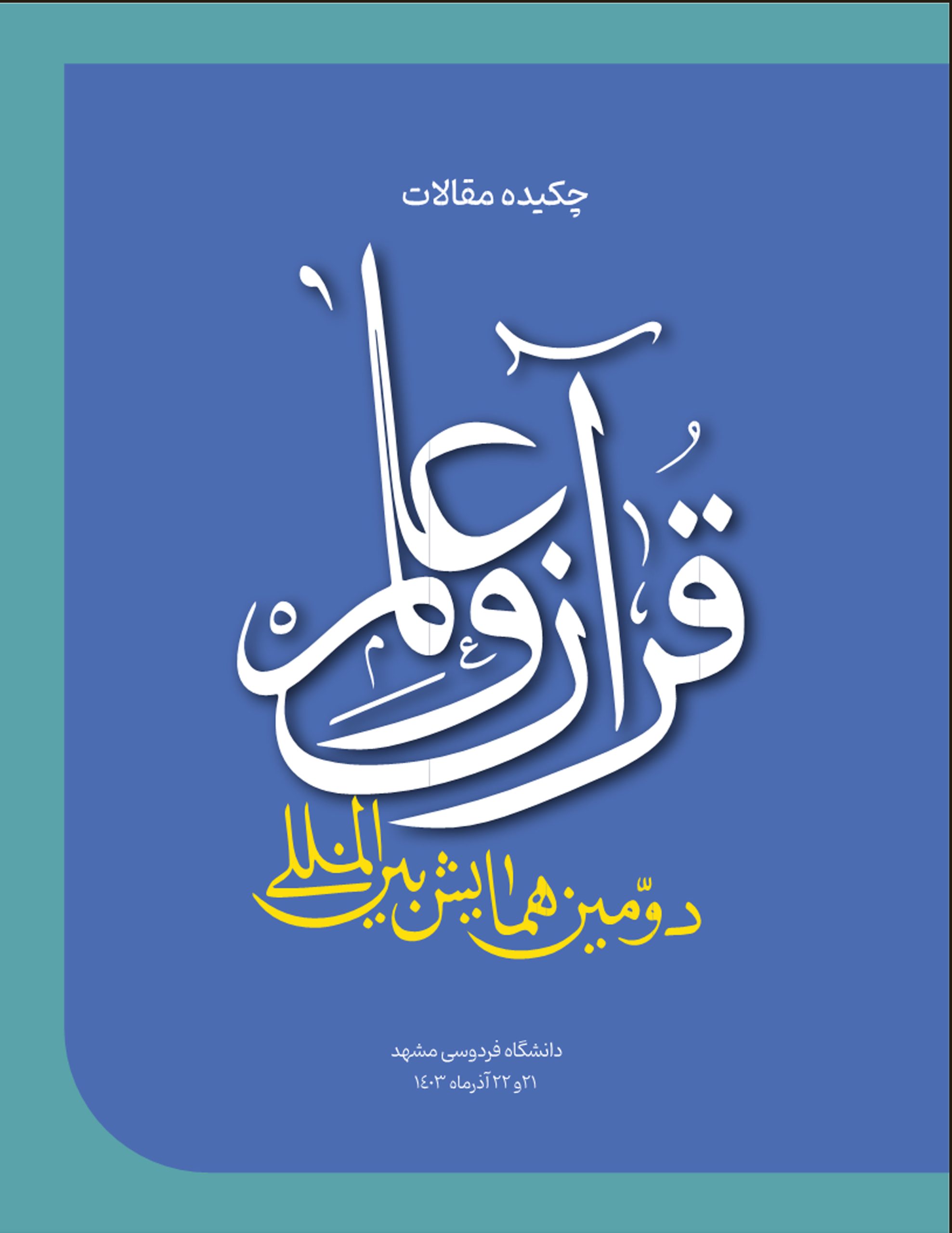
The speech by Dr. Rafat Motavalli, Scientific Secretary of the Second International Conference on Quran and Science, began with greetings and welcome to professors, researchers, and enthusiasts in the fields of Quran and science. At the outset of her speech, she paid tribute to the pure souls of the martyrs of the Sacred Defense and commemorated the martyr president, emphasizing that holding this conference is indebted to their pure intentions and divine grace.
Dr. Rafat Motavalli expressed gratitude for the collaboration of Dr. Jamileh Sadat Alamolhoda in opening new horizons in Quranic studies and expressed hope that this scientific path, through reliance on the Holy Quran, devotion to Imam Reza (AS), and the relentless efforts of scholars, would lead to effective and lasting results in scientific theorizing.
Subsequently, she provided a brief report on the accepted papers in this conference. According to her explanations, in this round, approximately 45 papers in the field of experimental sciences have been accepted, which, with a Quran-inspired approach, examine the challenges, potentials, and common horizons between the Quran and scientific paradigms. Among the themes of these papers are explaining the role of the Quran in the development of science and technology, inspiring the definition of new scientific problems, and analyzing potential conflicts between empirical data and revelatory concepts.
More than half of these papers are dedicated to the fields of medical and biological sciences. In the nutrition section, two distinct perspectives have been examined: first, a health-oriented view of natural elements such as honey, which the Quran has mentioned, and second, a semantic analysis of halal and haram foods, including in relation to modern studies such as microbiota.
On the topic of human creation, papers have been presented in the fields of embryology and evolutionary theories. Additionally, five papers are dedicated to examining animals mentioned in the Quran, including the conversations of ants, the behavior of honeybees, the memory of crows, the characteristics of spider webs, and the role of the whale in the story of Prophet Yunus.
In the axis of new technologies, four lectures are planned in the fields of artificial intelligence and information technology. Two papers also analyze numerical computations in complex social and economic systems.
In the cosmology and earth sciences section, papers on the beginning of the universe, night sky observation, and studies related to rain, clouds, and the water cycle have been accepted. In the field of physics, a paper titled “The Functioning of the World in the Quantum Domain” has been presented, and in chemistry, discussions on nanomaterials and photocatalysts will be addressed.
Additionally, papers in the field of Quranic psychology and epistemology have been presented, addressing topics such as explaining the components of the mind in the Quran, the effects of Quran-recommended behaviors, cognitive capabilities from the perspective of revelation, the effects of physical waves on human behavior, and the bidirectional connection between the heart and the brain.
At the end of her speech, Dr. Motavalli thanked the sincere efforts of the members of the scientific and executive committees of the conference and did not consider this Quranic scientific circle to be limited to Iran’s borders but rather an open platform for the participation of thinkers from all over the world. She reminded that many of today’s world problems, including health crises, the environment, and water resources, can be pursued and analyzed by re-reading divine verses and extracting problem-solving models from the Quran.
Dr. Rafat Motavalli also announced that from the third congress onward, side exhibitions will be held to showcase scientific and practical achievements derived from Quranic teachings. At the end, she proposed the establishment of the “Martyr President” scientific award in the form of student festivals to support innovative research centered on Quranic inspiration.
She concluded her speech by expressing hope for the formation of original and powerful theorizing in the light of the continuous efforts of Quranic elites.