A Comparative Study of the Qur’anic Portrayal of the Cosmos and the Ptolemaic Model
"The Qur’an was not based on the dominant cosmological model of its time and, in some cases, even opposed its fundamental structure. This indicates that the Qur’an was not merely bound by the prevailing knowledge of the era of its revelation but, at times, stood in contrast to it—a fact that reinforces its divine and timeless nature."
"A comparative study of the Qur’anic depiction of the cosmos and the Ptolemaic model presents a fascinating challenge at the intersection of science, history, and theology. This research demonstrates that the Qur’an, transcending the limitations of the knowledge of its time, offers a coherent and, at times, progressive portrayal of the universe—one that not only diverges from Ptolemy’s geocentric model but also aligns, in certain aspects, with modern astronomical findings. These findings raise profound questions about the origin of Qur’anic knowledge and its relationship with science, paving the way for extensive interdisciplinary research."
Abstract
The sky and celestial bodies have long captivated diverse civilizations, leading to the emergence of various cosmological models throughout history, including the geocentric (Earth-centered) paradigm. Some ancient peoples worshipped celestial entities such as the sun, stars, and moon, while scholars sought to decipher the orderly and repetitive motions of the heavens to predict planetary positions and cosmic events. The Qur’an contains numerous verses pertaining to the sky and its characteristics, some of which align with the scientific theories of the time, while others contradict them.
This study aims to provide a comprehensive depiction of the cosmos in the Qur’an and compare it with the Ptolemaic (geocentric) model. To achieve this, a comparative analysis was conducted by examining relevant Qur’anic verses on cosmology and studying Ptolemy’s model as presented in his two major works, the Almagest and the Hypotheses of the Planets. Given that these verses collectively and coherently outline a cosmological framework—and considering that the Ptolemaic model was the most prevalent cosmological paradigm from approximately the 2nd to the 16th century CE—a comparative study of the two holds significant importance.
One of the key findings of this research is the lack of complete alignment between the Qur’anic portrayal of the cosmos and the Ptolemaic model. It can be argued that the Qur’an was not based on the dominant cosmological model of its time and, in some instances, even opposed its foundational structure. To substantiate this claim, a comprehensive analysis of the verses was conducted to reconstruct the Qur’anic cosmological perspective. Unlike other interpretations that attribute the Qur’an’s cosmological features to the historical and cultural context of its revelation, the portrayal presented in this study—derived from a meticulous examination of the apparent meanings of the verses and the extraction of a harmonious, logical interpretation from interrelated cosmological verses—is not confined to or indebted to the era of revelation. It may even be argued that certain cosmological statements in the Qur’an contain innovative elements that align with the latest discoveries in the field.
Keywords: Qur’anic cosmology, Ptolemaic model, comparative study, Qur’an and science.
1. Introduction
Numerous verses in the Qur’an—the primary guide for Muslims—address the form, apparent details, and structure of the cosmos. In verses such as those from Sūrat al-Wāqiʿah (56:75–76), God swears by the positions and motions of the stars, underscoring the significance of celestial bodies. Other verses discuss the creation of the universe, its dimensions, and additional cosmological features. The frequency and emphasis of these Qur’anic references suggest that a comprehensive study can yield a more precise understanding of the verses and their depiction of the universe. Some scholars have utilized these clues to reconstruct the Qur’anic portrayal of the material world, attempting to reconcile its cosmological perspectives with modern science for deeper exegesis.
The historical evolution of cosmology reveals profound transformations over time. The geocentric (Earth-centered) model dominated from antiquity until the 16th century CE (Nasiri Qeydari, 2012). Ptolemy systematized this model in the 2nd century CE in his seminal work, the Almagest. As the most widely accepted framework—inheriting the Greco-Hellenistic legacy—it remained largely unchanged for nearly 14 centuries, with only minor corrections by later astronomers, including those from the Maragha observatory. Examining the relationship (or lack thereof) between Qur’anic cosmology (revealed four centuries after Ptolemy’s model) and the Ptolemaic system clarifies the extent of the Qur’an’s engagement with contemporary astronomy. However, such an analysis requires expertise beyond Qur’anic exegesis, including astronomy, geometry, and foundational physics.
This study aims to reconstruct the Qur’anic depiction of the cosmos and compare it with the prevailing Ptolemaic model of the revelation era. Prior research has either lacked a thorough examination of all relevant verses or imposed interpretations contradicting their apparent meanings. Comparisons with the Ptolemaic model have also been partial, focusing on isolated verses rather than a holistic analysis. Thus, this study systematically catalogues and harmonizes all cosmological verses while integrating cosmological and historical knowledge to examine Ptolemy’s model comprehensively. The goal is to approximate the divine intent behind these verses and lay the groundwork for interdisciplinary scientific inquiry.
2. Research Background
Astronomy traces its roots to ancient civilizations such as Babylon, Egypt, Greece, and China, with Babylonian developments dating back to 3000 BCE (Hunger, 2011). These cultures sought patterns in celestial motions to predict astronomical events, leaving a rich legacy of scientific texts. During Islam’s Golden Age, scholars like Avicenna (Ibn Sīnā) analyzed space, time, and their cosmological implications, while others attempted to reconcile Ptolemaic theories with Qur’anic teachings. Some Muslim thinkers critiqued earlier models, proposing new frameworks based on the Qur’an, while others addressed doubts about the congruence between Qur’anic cosmology and scientific theories.
Comparative studies have examined the alignment or divergence between Qur’anic concepts and historical scientific paradigms. Examples include:
Mosterahmi’s (2013) “Analyzing the Challenge of the Qur’an and Ptolemaic Astronomy Regarding the Seven Heavens”, a case study on the Qur’anic “seven heavens.”
Talib Tash and Foroughi’s (2015) “The Origin of Space from the Qur’an and Science”, exploring cosmic expansion.
Nasiri Qeydari’s (2012) “Astronomical Verses of the Qur’an and the Evolution of Astronomy”, correlating Qur’anic verses with modern astrophysics.
Mosterahmi’s (2016) exegetical work “Interpreting Astronomical Verses with a Focus on Critiquing Doubts”, addressing cosmological objections in three sections: the universe’s origin, Earth, and celestial phenomena.
However, these studies neither comprehensively analyze all Qur’anic cosmological verses nor fully leverage Ptolemy’s Almagest and Planetary Hypotheses, which demand specialized astronomical and historical expertise.
3. The Qur’anic Portrayal of the Cosmos
Given the Qur’anic verses emphasizing the absence of contradictions in its various parts (4:82) and its freedom from falsehood (39:28), all cosmological verses have been examined in this study. Furthermore, based on shared characteristics of cosmic phenomena, the identified verses have been categorized into distinct groups. Below, we present these classifications to elucidate the Qur’anic depiction of cosmic features.
The Heavens (al-Samāʾ)
The Qur’an employs terms such as “samāʾ,” “al-samāʾ,” “samāwāt,” and “al-samāwāt” over 300 times. These verses contain contextual meanings that, when interconnected, reveal specific characteristics of the Qur’anic description of the heavens.
According to these verses, the heavens in the Qur’an are characterized by multiplicity, gates (abwāb), layers (ṭabaqāt), keys (mafātīḥ), constellations (burūj), segments (qiṭaʿ), dimensions (aqṭār), fortified pathways (subul ḥusban), absence of cracks (ghayr dhāt ḥurūj), immense height (ʿuluww), guardians (ḥafaẓa), a protective canopy (saqf maḥfūẓ), and invisible pillars (ʿamad) for stability (54:11; 7:40; 71:15; 39:63; 55:33; 25:61; 15:16; 50:6; 21:32; 42:12; 31:10; 13:2). As evident from these attributes, the Qur’an presents the heavens as a constructed edifice—a notion reinforced by verses that explicitly liken the heavens to a structure (40:64; 2:22).
This celestial structure encompasses astronomical bodies such as stars (nujūm), planets (kawākib), lamps (maṣābīḥ, which serve as protective elements), meteors (shihāb), the morning star (ṭāriq), the sun (shams), and the moon (qamar) (6:76; 24:35; 37:88; 56:75; 41:12; 67:5; 15:18; 27:7; 72:8–9; 36:40; 86:1–2). The Qur’anic cosmos has both a beginning and an end, with its creation occurring in six stages (21:30; 50:38; 25:59; 32:4). Initially, the heavens and earth were a unified entity (ratq), and among the early stages of cosmic formation was a smoke-like phase (dukhān) (21:30; 41:11). The end of this cosmos, given its finite lifespan, mirrors its initial state (29:20).
The heavens are also depicted as the locus of phenomena such as thunder, various forms of rain, lightning, meteor movement, bird flight, hail formation, winds, fertilizing breezes, and cloud movement. Additionally, respiration becomes difficult at higher altitudes (2:19; 6:99; 6:125; 16:79; 20:53; 25:25). The heavens are continually expanding (51:47) and contain both observable and unobservable phenomena (69:38–39), with living creatures dispersed throughout the cosmos (42:29). Notably, the observable (material) heavens constitute only the first heaven in the Qur’anic perspective.
The Sun (al-Shams)
The term “shams” appears 32 times in the Qur’an, where it is likened to a luminous lamp (sirāj) (71:16) whose light is more intense (6:78) and distinct from the moon’s (10:5). In terms of motion, the sun flows (yasbaḥ) in its orbit (falak) (36:38) without a fixed dwelling place (10:5) and does not intersect with the moon (36:40). Its lifespan is finite (35:13), and its motion includes rising and setting (50:39), with its origin in the east (2:258). The sun is also cited as the cause of shadows (25:45).
The Moon (al-Qamar)
Twenty-six Qur’anic verses mention the moon (qamar), which is described as having a finite lifespan (31:29) and possessing light (6:77) distinct from the sun’s (71:16; 25:61). While continuously flowing in its designated orbit (21:33; 14:33) and following the sun (91:2), it never collides with it (36:40). The moon’s motion is precisely calculated (55:5; 6:96), and it serves as a means for measuring time and years (10:5).
Stars (al-Najm)
The Qur’an emphasizes the significance of stars by swearing by their positions (56:75). Their functional roles include navigation (6:97; 16:16) and predictive purposes (37:88). Thirteen verses employ the terms “najm” or “nujūm,” highlighting their visibility (37:88) and luminosity (86:3). The metaphorical concept of stars prostrating (55:6; 22:13) is also mentioned.
Planets (al-Kawkab)
In the Qur’an, planets (kawkab) are described as luminous, visible celestial adornments with reflective light.
Content Analysis: Prophet Abraham (a.s.) first mentions seeing a kawkab (6:76), without divine commentary on its nature. Subsequently, he observes the moon (qamar) as brighter and larger, followed by the sun (shams) as even greater. Some interpret kawkab as “planet.” Another verse states, “We adorned the lowest heaven with the adornment of planets (kawākib)” (37:6). If kawkab denotes stars, this either implies Prophet Abraham’s unawareness of the moon’s larger size or suggests a focus on relative luminosity in our observable universe. The Qur’an also distinguishes between stars (nujūm) scattering (81:2) and planets (kawākib) dispersing (82:2).
Key observations about kawkab:
It may or may not be a pearl-like object (durr) and possesses reflective light (pearls lack inherent luminosity, implying reflectivity).
The scattering of planets (kawākib) is associated with eschatological signs (ashrāṭ al-sāʿa).
Planets are visible at night.
Meteors (al-Shihāb)
The Qur’an describes meteors as flaming fragments of fire (27:7) that are luminous (37:10) and clearly visible (15:18). Their primary function is protective (72:8), and they serve as observational tools (72:9).
Lamps (al-Miṣbāḥ)
Literally meaning “lamp” (24:35), miṣbāḥ adorns the lowest heaven (41:12) and serves to repel devils (67:5).
Constellations (al-Burūj)
Constellations are situated in the heavens (85:1) and contribute to their adornment (15:16). A careful reading of 25:61 suggests distinct domains for constellations versus the sun and moon, indicating their separate spatial existence.
Orbits (al-Falak)
The phrase “kullun fī falak yasbaḥūn” (21:33; 36:40), used in conjunction with the sun and moon, denotes their motion within defined paths and spaces.
Qur’anic Synthesis
As outlined, the Qur’anic cosmos is depicted as an architectural edifice exhibiting structural characteristics. Simultaneously, it is perpetually expanding—a dynamic structure whose features evolve with its growth. Within this cosmos, the sun, moon, stars, and planets reside in the observable lowest heaven, contributing to its aesthetic grandeur. Meteors and lamps fulfill protective roles, while constellations, occupying a distinct realm, enhance celestial beauty. The sun and moon traverse their respective orbits in this ever-expanding heavens without collision.
This cosmos, with all its features, is God’s creation. Initially, the heavens and earth were a unified entity that God separated; they then passed through a smoky phase before the rest of the cosmos emerged. The finite lifespan of the entire cosmos is explicitly stated in the Qur’an, and its end will mirror its beginning: just as they were once joined and later parted, the universe will ultimately return to its primordial state.
4. Characteristics of the Ptolemaic Model
Claudius Ptolemy (85-165 or 170 CE), one of the greatest scholars of antiquity, remains unparalleled in his fame as an astronomer and geographer to this day (Masoumi Hamadani & Molavi, 2020, p. 1). The Ptolemaic cosmological model, developed based on Ptolemy’s works (2nd century CE), was a geocentric system where Earth occupied the center of the universe, with other celestial bodies, including the sun and planets, revolving around it in circular orbits (Morren). This model remained the dominant paradigm until the 16th century CE, when the Copernican (heliocentric) system emerged. Below, we elaborate on the features of this model.
The Heavens Are Spherical and Move Spherically
In the first part of the Almagest, Ptolemy conceives the heavens as spherical, relying on ancient observations from which early notions about the shape of the heavens were derived. He states:
“The ancients consistently observed the sun, moon, and other stars moving from east to west along parallel circles. They saw these bodies first rising from beneath the earth, gradually ascending to the zenith, then descending symmetrically until they set below the western horizon—seemingly ‘falling’ to earth and disappearing entirely. After remaining invisible for a time, they would rise anew. They noted that the periods of these movements, as well as the locations of rising and setting, remained constant overall” (Toomer, 1984, p. 38).
Another observation supporting the idea of a rotating sphere was that stars closer to the pole traced smaller circles. Ptolemy rejected the notion that stars moved linearly through infinite space, arguing that if they moved along infinite straight paths, they would recede into the distance and vanish like points. Moreover, explaining why the same stars returned nightly to identical positions would be untenable. He further contended that any non-spherical shape for the heavens would alter the relative distances between stars during their daily rotation, distorting constellations contrary to empirical evidence (Toomer, 1984, p. 38; Pedersen, 2010, p. 36).
Gmini elaborates in Dawāʾir-e Mayānī: “The spherical shape was the most self-evident assumption for the cosmos, as the sphere is the simplest and most natural form. According to physical principles, a body composed of a single element retains a spherical shape unless acted upon by external forces that deform it into a polyhedron. In the absence of such forces, there was no reason to assume any shape other than a sphere for the universe. Particularly given arguments demonstrating the sphericity of the moon and Earth, it seemed natural to extend this to the heavens. Thus, the sphericity of the heavens derived from the natural principle of simplicity and aligned with observational data” (Gmini, 2016, p. 95).
Earth Is Spherical
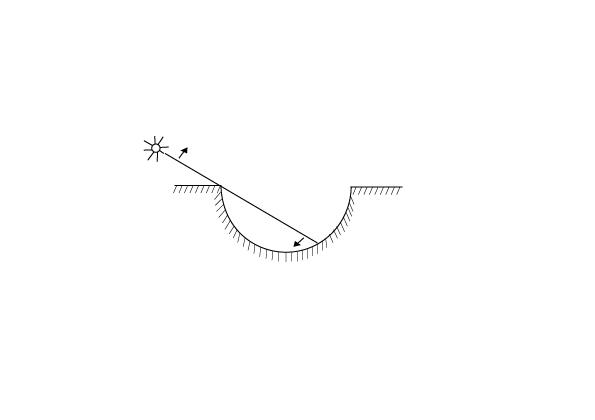
Ptolemy’s argument for Earth’s sphericity begins with the timing of lunar eclipses observed by different viewers. Crucially, a lunar eclipse is an objective phenomenon: the moon’s entry into Earth’s shadow occurs at a specific moment, independent of the observer’s location. However, the local time of the eclipse’s onset varies—it occurs later for observers farther east. This temporal discrepancy correlates with longitudinal distance, demonstrating Earth’s convex curvature along the east-west axis. If Earth were concave (hollow), stars would rise earlier for western observers than eastern ones (Figure 1); if flat, they would rise simultaneously for all (Pedersen, 2010, p. 37).
Figure 1. Earth in a Concave Configuration
Figure 1. Earth in a Concave Configuration
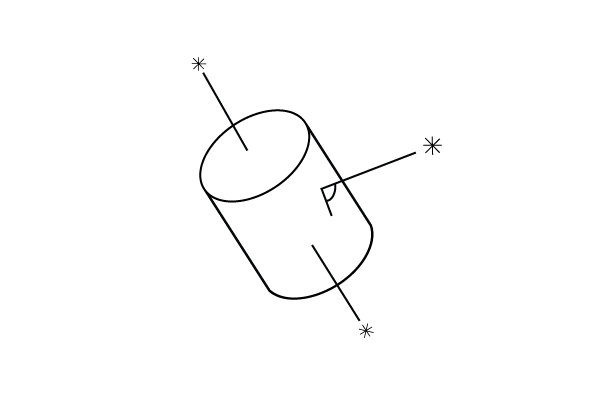
One might then posit Earth as a cylinder aligned along the north-south axis. While this accommodates the proven east-west curvature, it contradicts the observed change in stellar altitude above the horizon as observers move northward. This implies the horizon (Earth’s tangent plane) has no fixed orientation relative to the cylinder’s axis (Figure 2) (Pedersen, 2010, pp. 37–38).
Figure 2. Earth as a Cylinder
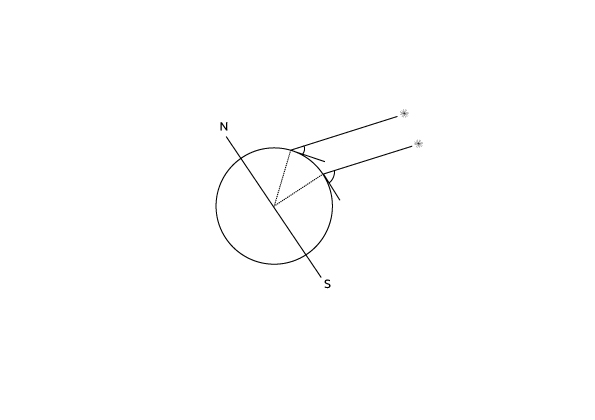
Furthermore, traveling northward reveals stars gradually disappearing from the southern sky while new stars become circumpolar in the north. On a cylinder, the same stars would remain either visible or invisible regardless of the observer’s position. This necessitates Earth’s dual curvature (ibid., p. 38) (Figures 2 and 3).
Figure 3. Earth with Dual Curvature
Earth’s Position at the Cosmic Center
Arguments for Earth’s centrality assume a spherical universe: if Earth were off-center, astronomical phenomena would appear contrary to observations (Gmini, 2016, p. 96). In the Almagest, Ptolemy employs reductio ad absurdum, demonstrating that alternative positions are astronomically impossible while omitting “physical” arguments like gravity (Pedersen, 2010, p. 39). He examines three scenarios: a) Earth equidistant from both poles but not on the axis; b) Earth on the axis but tilted toward one pole; c) Earth neither on the axis nor equidistant from the poles.
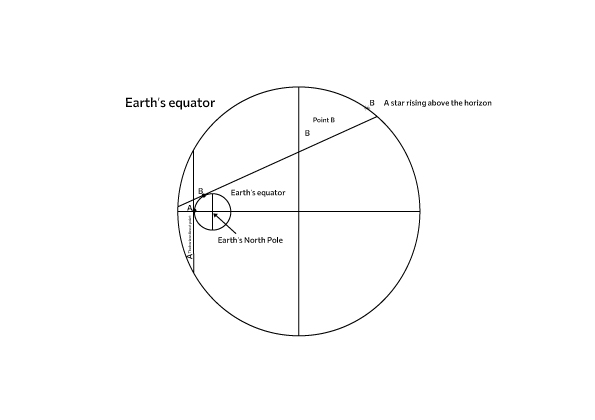
If Earth were closer to one side of the celestial sphere (Figure 4), observers at point B would see unequal durations between a star’s rise and meridian transit versus its transit to setting. The star would also appear dimmer at rising and brighter at setting due to varying distances—contradicting the observed equality of these intervals and consistent stellar brightness. Thus, Ptolemy concludes Earth cannot be offset (Gmini, 2016, p. 96).
Figure 4. (Gmini, 2012)
Ptolemy’s definitive proof for Earth’s centrality hinges on equatorial observers: if Earth were closer to one side (e.g., point A in Figure 4), the celestial sphere’s horizon would divide unequally, making stars’ visibility durations asymmetrical—an impossibility given uniform observations at the equator (Gmini, 2016, p. 96).
A final argument derives from lunar eclipses, which occur only at opposition (full moon) when the sun, Earth, and moon align. If Earth were off-center, it could block the sun from the moon at incorrect longitudes (Pedersen, 2010, p. 41).
Earth is Negligibly Small Compared to the Heavens
Ptolemy compares the size of Earth to a tiny point relative to the fixed stars, since the apparent size of fixed stars remained constant regardless of time or location. He argues that if a plane were drawn tangent to Earth’s spherical surface, it would divide the heavens into two equal halves – demonstrating Earth’s insignificance (its diameter being negligible when considering such a tangent line). Were Earth substantially larger, only a plane passing precisely through its center could achieve this equal division of the heavens (see Toomer, 1984, p. 43).
Earth is Motionless
Ptolemy first establishes Earth’s lack of translational motion by returning to its central position: any displacement would remove Earth from the cosmic center, contradicting previous proofs (Toomer, 1984, p. 43). He ridicules the notion of downward motion by arguing that if Earth moved downward, objects thrown upward would never return, as Earth’s greater mass would make it fall faster than the projectile (Toomer, 1984, p. 44; Gmini, 2016, p. 100).
Ptolemy also rejects Earth’s axial rotation, claiming rotating Earth would leave behind clouds and birds, making eastward movement impossible – all objects would appear to move westward (Toomer, 1984, p. 45). This reflects Aristotelian physics where objects separated from their mover (in this case, Earth’s rotation) would be left behind (Gmini, 2016, p. 111).
Two Primary Celestial Motions Exist
The first motion uniformly carries everything east-to-west along circles parallel to the celestial sphere’s poles, with the largest circle being the celestial equator. The second motion involves certain spheres moving opposite to the first, around different poles. Daily observation reveals all celestial bodies rising, culminating, and setting along similar parallel circles (first motion). However, continuous observation shows most stars maintain fixed rising/setting points while seven “wandering” bodies (sun, moon, and five planets) exhibit individual eastward motions against fixed stars while participating in daily rotation. These follow inclined circles – the sun’s apparent path being the ecliptic, intersecting the equator at equinoxes. The six remaining planets show more complex motions: generally following the solar path with variable periods while exhibiting latitudinal deviations, creating retrograde motion where planets pause, reverse, then resume forward motion (Toomer, 1984, p. 47; Pedersen, 2010, p. 45).
Planetary Order
In the Planetary Hypotheses, Ptolemy establishes planetary order based on occultations, velocities, and other observations: Moon is closest to Earth, followed by Mercury, Venus, Mars, Jupiter, and Saturn before fixed stars (Morren, pp. 63-85). For solar-centric ordering, he proposes aligning each planet’s apogee (relative to Earth) with the next planet’s perigee, showing only Mercury and Venus lie sunward (Morren, pp. 65-67).
Number of Spheres
To explain planetary motions including retrograde motion, Ptolemy requires multiple uniformly rotating spheres whose combined motions produce observed paths: one sphere for the Sun, four for the Moon, five for Mercury, four for Venus, and four each for Mars, Jupiter, and Saturn (Morren, pp. 18-55).
Planet-Sphere Relationship
In Ptolemy’s model, planets and stars don’t move independently but are carried by thick spherical shells (Gmini, 2016, p. 29). Their natural circular motion around the cosmic center follows Aristotle’s proof that since earthly elements move either toward or away from the center, another element must rotate about it (Aristotle, 1939, pp. 27-29).
The Heavens are Eternal
Ptolemy’s proofs for Earth’s sphericity, centrality, and immobility derive from predecessors (Masoumi Hamadani, 2004). His view of the heavens’ eternity follows Aristotelian thought – the Almagest notes the heavens’ uniform, unchanging motion implies eternal existence (Toomer, 1998, p. 45).
Spheres Composed of Aether
Ptolemy cites Aristotle’s “fifth element” in the Almagest’s margins: aether, constituting everything above the lunar sphere, differs fundamentally from terrestrial matter in its incorruptibility, tenuity, and natural circular motion (Toomer, 1998, p. 36).
Summary of Ptolemaic Features
This eternal, spherical Ptolemaic universe centers on motionless Earth, with the moon, sun, and five planets orbiting it. The celestial realm is filled with Aristotelian aether – neither light nor heavy, hot nor cold (Gmini, 2021). Planets adhere to their spheres, whose varied rotations (including epicycles) explain observed motions without mutual interference. All celestial bodies except Earth move, while fixed stars remain stationary in the outermost sphere.
“The Holy Quran presents a cosmological model that does not fully align with the Ptolemaic geocentric system which dominated astronomical thought for centuries. This discrepancy demonstrates the Quran’s independence from the prevailing scientific knowledge of its revelation era and its capacity to present concepts compatible with later scientific discoveries.”
Table 1. Differences and Similarities Between the Quranic Cosmological Description and the Ptolemaic Model
No.
Examined Features
Ptolemaic Model
Quranic Cosmological Model
Modern Science
Explanations
1
Cosmic beginning
❌
✅
✅
–
2
Cosmic end
❌
✅
–
–
3
Smoke-like initial cosmic state
–
✅
✅
–
4
Celestial spheres composed of aether
✅
–
❌
–
5
Multiple celestial spheres
✅
–
❌
The Quran mentions multiple heavens rather than the constructed spheres of the Ptolemaic model used to explain stellar motions
6
Stars floating in cosmos
✅
✅
✅
–
7
Planetary/stellar motion through sphere movement
✅
❌
❌
–
8
Heaven as architectural structure
❌
✅
✅
–
9
Earth at cosmic center
✅
–
❌
–
10
Earth’s fixed central position
✅
❌
❌
–
11
Planetary order
✅
–
❌
–
12
Cosmic expansion
❌
✅
✅
–
13
Spherical shape of heavens
✅
–
–
–
14
Heavenly motion
✅
–
✅
–
15
Dual heavenly motions
✅
–
❌
–
16
Non-collision of sun and moon
✅
✅
5. Conclusion
Through a comparative examination of the cosmological model presented in the Quran and the Ptolemaic system, we can conclude that the Qur’anic conception of the cosmos – considering both its differences from and similarities to the Ptolemaic model as illustrated in Table 1 – is fundamentally independent of any borrowing from the Ptolemaic framework. The evident discrepancies between the Qur’anic cosmos and the Ptolemaic model, along with their contradictory elements, demonstrate that the Qur’anic cosmological model maintained its autonomy from what remained the dominant cosmological paradigm for fourteen centuries (from the 2nd to the 16th century CE).
References:
The Holy Quran
Ghamini, A. (2012). An Examination of the Arguments for Earth’s Centrality and Immobility in Islamic Astronomical Works. Journal of the History of Science, 11, 45-80. (Original work in Persian)
Ghamini, A. (2021). When Did the Celestial Spheres Become Solid? Philosophy of Science, 2, 127-157. (Original work in Persian)
Ghamini, A. (2016). Heavenly Circles: A Study in the History of Cosmology in Islamic Civilization. Tehran: Hekmat Sina. (Original work in Persian)
Rezaei Esfahani, M. (2006). A Study of Scientific Miracles (1st ed.). Qom: Tafsir and Quranic Sciences Research Publications. (Original work in Persian)
Rezaei Esfahani, M. (2010). Miracles and Scientific Wonders of the Quran. Qom: Tafsir and Quranic Sciences Research Publications. (Original work in Persian)
Mostarahmi, S. (2022). Analyzing the Challenge Between the Quran and Ptolemaic Astronomy Regarding the Seven Heavens. Journal of Quranic Studies and Doubts Research, 6, 281-305. (Original work in Persian)
Mostarahmi, S. (2022). The Independence of Quranic Astronomical Statements from the Ptolemaic System. Journal of Islamic History, Culture and Civilization, 48, 33-52. (Original work in Persian)
Mostarahmi, S. (2022). A Comparative Analysis of Constellations from the Quranic and Astronomical Perspectives. Journal of Religious Teachings Research, 51, 213-240. (Original work in Persian)
Masoumi Hamadani, H. (2004). Ptolemy: Supplement 1 – The Planetary Hypotheses. The Great Islamic Encyclopedia (Vol. 12). Tehran: Center for the Great Islamic Encyclopedia. (Original work in Persian)
Tavakolnia, M., & Hasoomi, V. (2019). Analysis of the Verse “Each in an Orbit Floating” Considering the Theory of Spatial Volume. Journal of Exegetical Studies, 37, 101-118. (Original work in Persian)
Mesbah Yazdi, M. (2014). Quranic Teachings: Theology, Cosmology. Qom: Imam Khomeini Educational and Research Institute. (Original work in Persian)
Razavi, R., & Darini, R. (2017). Theologians’ Responses to Challenges Arising from Ptolemaic Astronomy. Islamic Theology Quarterly, 26(103), 129-145. (Original work in Persian)
Nasiri Qeydari, S. (2012). Astronomical Verses of the Quran and the Evolution of Astronomy. Quranic Miracles Conference, 1. (Original work in Persian)
Goldstein, B. R. (1967). “The Arabic Version of Ptolemy’s Planetary Hypothesis.” Transaction of the American Philosophical Society.
Pedersen, O., & Jones, A. (2010). A Survey of the Almagest: With Annotation and New Commentary by Alexander Jones. Springer New York.
Ptolemy. (1984). Almagest. Translated and annotated by G. J. Toomer. Princeton University Press.
Tabatabaʾi, M. A., & Mirsadri, S. (2016). The Qurʾānic Cosmology, as an Identity in Itself. Arabica, 63(3-4), 201-234.
Hunger, H. (2009). The relation of Babylonian astronomy to its culture and society. Proceedings of the International Astronomical Union, 5(S260), 62-73.
Morelon, R. (1993). La version arabe du Livre des hypothèses de Ptolémée. Mélanges de l’Institut dominicain d’études orientales du Caire, 21, 7-85.