A Meta-Synthesis of Studies on the Concept of the “Heart” in the Qur’an
"In the Qur’an, the "heart" (qalb) is not merely a physical organ but the central core of human existence, interconnecting bodily, psychological, and spiritual dimensions. Deciphering its mysteries holds the key to understanding the miraculous interplay between divine revelation and scientific inquiry."
Studying the concept of the heart in the Qur’an presents an interdisciplinary challenge that transcends the boundaries of religious exegesis, philosophy of mind, and neuroscience. Through a meta-synthesis of 24 credible studies, this research demonstrates how the Qur’anic framework simultaneously interprets the heart as a "pineal organ," the "third ventricle of the brain," and a "locus of spiritual intuition." Findings reveal that 72% of the examined articles regard the heart as pertaining to a metaphysical realm, while 28% focus on its scientific-physiological explanations. This dichotomy not only highlights the need for deeper dialogue between empirical sciences and theology but also raises fundamental questions about the nature of consciousness and the mind-body connection. Has the time come to move beyond traditional dualism toward an integrated model of the heart as a "multi-layered nucleus"?
Abstract
This study aims to conduct a meta-synthesis of existing research on the cognitive functions of the heart and its ontological nature in the Qur’an. Employing a meta-synthesis methodology, the paper analyzes qualitative studies and their interpretive frameworks. The sample comprises 24 peer-reviewed articles published between 2009 and 2024 in Persian and English, all adopting Islamic and Qur’anic perspectives. The primary research questions are: What interpretations do prior qualitative studies offer regarding the Qur’anic concept of the heart? What analytical commonalities exist among these studies? And what future research trajectories do they suggest?
The results indicate that 72% of the articles associate the Qur’anic heart with a spiritual, trans-corporeal essence, while 28% approach it from a somatic perspective—of which 4% link it to the brain’s third ventricle and 24% to the pineal organ in the chest. Thematically, the studies explore the heart’s correlations with the nafs (self), brain, pineal heart, sadr (chest), and related constructs. Additional themes include cardiac health, general cardiac functions, and mystical interpretations of the heart. Methodologically, the articles combine Qur’anic analysis with exegetical, philosophical-mystical, literary-semantic, and medical approaches.
Ultimately, this meta-synthesis suggests that existing research captures only a fraction of the heart’s reality in the Qur’an. Further exploration demands precise empirical discoveries to illuminate the miraculous dimensions of divine revelation. Synthesizing diverse perspectives, we propose a model of the heart as a central nucleus enveloped by interconnected physical, psychological, and spiritual layers, each influencing the others.
One of the most pivotal concepts in Qur’anic epistemology is the notion of the “heart” (qalb). This term appears in 132 verses of the Qur’an (Abd al-Bāqī, 1945/1364, pp. 549–551) and has consistently been a subject of interest for exegetes and researchers. The primary reason for this scholarly attention lies in the Qur’an’s attribution of cognitive functions to this pineal organ, assigning it a central role in perception (al-Aʿrāf: 179; al-Tawbah: 87, 93, 127; al-Munāfiqūn: 3) and even rational cognition (al-Ḥajj: 43; Qāf: 37).
However, most classical and contemporary exegetes argue that the heart (qalb) itself lacks innate consciousness or perception. They contend that the Qur’anic usage of this term metaphorically refers to the intellect (ʿaql), self (nafs), or soul (rūḥ) (Rāghib al-Iṣfahānī, 1412 AH, p. 682; Ṭabāṭabāʾī, 1973/1352, vol. 2, p. 224; Muṣṭafawī, 1989/1368, vol. 9, p. 305; Ṭabrisī, 1408 AH, vol. 9, p. 224; Ibn ʿĀshūr, 1420 AH, vol. 1, p. 252; Riḍā, 1414 AH, vol. 9, p. 420).
Notably, the concept of the heart and its cognitive faculties is not exclusive to the Qur’an. Long before its revelation, various religions and civilizations regarded the heart as the locus of emotions, thoughts, and volition. Hence, a historical perspective on this subject is indispensable, as demonstrated by researchers who have traced its conceptual genealogy (ʿUqba & Mahroos, 2019/1398, pp. 77–94).
Furthermore, a proper understanding of the heart necessitates an examination of modern scientific and medical literature. A groundbreaking discovery in this field was made in 1991 by Dr. J. Andrew Armour, who identified the heart’s intrinsic nervous system—comprising approximately 40,000 neurons—capable of functioning independently of the brain (Armour, 1991, pp. 331–341).
Given the diversity of interpretations surrounding the Qur’anic concept of the heart and recent empirical discoveries, a systematic review of existing literature is imperative. To date, no study has undertaken a meta-synthesis of research on the heart in the Qur’an, making this inquiry a novel contribution to the field.
This study addresses the following research questions:
What interpretations of the Qur’anic concept of the heart have prior qualitative studies proposed?
What analytical commonalities exist among these studies?
What future research directions do recent studies suggest?
2. Research Methodology
Given the increasing application of qualitative research across various disciplines, there is a need to synthesize their results in a coherent and organized manner to derive more integrated and practical theories. Meta-synthesis can be employed to combine and integrate primary qualitative studies and their findings. Meta-synthesis is a type of qualitative study that utilizes the findings of other qualitative research on a specific topic as data. Thus, the samples for meta-synthesis consist of qualitative studies selected by the researcher based on the research question of interest (Sandelowski, 2008, p. 105). Essentially, meta-synthesis is presented in a way that allows the results of primary studies to remain traceable, with the goal of providing explanations and facilitating a more comprehensive understanding of phenomena. In other words, meta-synthesis seeks to unify the results of qualitative studies to uncover their fundamental concepts and transform them into a final, unified concept. Meta-synthesis can be conducted using various approaches; the primary approach in this study is interpretive synthesis, with a focus on theoretical and conceptual development (Abedi Jafari & Miri, 2019/1398, p. 78). Additionally, this method can be implemented using different models; this study follows Sandelowski and Barroso’s seven-stage model. The stages of this seven-step method are as follows: formulating research questions, systematic literature review, searching and selecting appropriate articles, extracting data from articles, analyzing and synthesizing findings, quality control, and presenting results (Sandelowski & Barroso, 2007).
In this study, the research objectives and questions were first defined. Then, in the second and third steps, the research population was formed to address these questions. The research population consists of credible articles that examine the concept of the heart from various Qur’anic and Islamic perspectives. To this end, keywords such as “heart in the Qur’an,” “nature of the heart,” “intellect of the heart,” “cardiac intelligence,” “function of the heart,” “perception of the heart,” etc., were searched in databases and journals such as Semantic Scholar, Google Scholar, PubMed, Noormags, Magiran, and Civilica. After identifying and collecting approximately 40 articles, a review revealed that some of these documents were not closely related to the main issues of this research, as they approached the topic from purely literary or ethical perspectives or from non-Qur’anic and non-Islamic viewpoints. Consequently, these documents were excluded from the study population, and ultimately, 24 research articles most relevant to the topic were selected. In the fourth step, all selected studies were thoroughly reviewed, and the results extracted from their content were categorized by concept. In the fifth step, the categorized results, arguments, and concepts were grouped, and duplicates were removed. In the sixth step, the content of each category was examined, compared, and analyzed. In the seventh step, the results from each category were synthesized to establish necessary connections among them.
It should be noted that all studies in the research population were published between 2009/1388 and 2024/1403. Although some books and theses were also written during this period, only articles were included in the study population because independent research articles had been extracted from these works. Additionally, only Persian and English articles were analyzed in this study. The list of studies included in this meta-synthesis is presented in the table below.
Table 1. List of Studies Included in the Meta-Synthesis
No.
Title of Study
Author(s)
Author Affiliation
Publication Details
Year
1
“The Heart in the Qur’an and Arabic Literature: Reality or Metaphor?”
Yahya Ma’ruf
Associate Professor, Department of Arabic Language and Literature, Razi University, Kermanshah
Article in Scientific Journal of the Iranian Association of Arabic Language and Literature, No. 13
2009/1388
2
“The Mystery of the Term ‘Heart’ in the Qur’an (Reality or Metaphor)”
Mohammad Nabi Ahmadi; Abbas Haj Zain al-Abedini
Assistant Professor, Arabic Department; Assistant Professor, Theology Department, Razi University, Kermanshah
Article in Scientific Journal of the Iranian Association of Arabic Language and Literature, No. 22
2012/1391
3
“The Position and Role of the Heart in Mystical Ethics”
Fatemeh Ahmadi; Shahnaz Ghahremani
Assistant Professor, Islamic Azad University, Garmsar Branch; PhD Candidate in Islamic Studies, Baqir al-Uloom University, Qom
Article in Journal of Ethical Research, No. 4
2013/1392
4
“The Epistemological Position of the Heart in the Qur’an”
Hasan Abdi
Assistant Professor and Researcher in Seminary and University
Article in Qur’an and Epistemology, Tehran: Islamic Research Institute for Culture and Thought
2013/1392
5
“Educational Implications of the Semantics of the Heart in the Qur’an”
Mohammad Delbari
PhD in Qur’an and Hadith, Head of Qur’an and Islamic Studies Department, Educational Research and Planning Organization
Article in Research Journal of Qur’anic Interpretation and Language, No. 1
2016/1395
6
“The Concept of the Heart in Islam”
Amber Haque
Professor, Department of Psychology and Counseling, College of Humanities and Social Sciences, UAE University
Lecture at the Center for Study and Research, New Delhi, India
2017/1396
7
“The Function of the Heart in the Qur’an”
Begom Oghba; Farhang Mehroosh; Arasto Mirani
PhD Candidate, Qur’an and Hadith Department; Associate Professor, Theology Department; Assistant Professor, Theology Department, Islamic Azad University, Gorgan Branch
Article in Journal of Qur’anic Studies and Islamic Culture, No. 4
2018/1397
8
“Cognitive Analysis of the Nature of the Heart in the Qur’an”
Alireza Ghaemi Nia; Shaban Nasrati
Associate Professor, Epistemology Department, Islamic Research Institute of Culture and Thought; Assistant Professor, Imamite Theology Department, Qur’an and Hadith Research Institute
Article in Journal of Mind, No. 84
2018/1397
9
“Genealogy of the Qur’anic Concept of the Heart”
Begom Oghba; Farhang Mehroosh
PhD Candidate, Qur’an and Hadith Department; Associate Professor, Theology Department, Islamic Azad University, Gorgan Branch
Article in Research Journal of Qur’anic Interpretation and Language, No. 14
2019/1398
10
“The Impact of Passive Reactions of the Sound Heart on Mental Health from the Qur’anic Perspective”
Seyyed Razieh Pourmohammadi; Mohammad Sobhani Yamchi
MA Student in Qur’anic Exegesis; Assistant Professor, Faculty of Qur’anic Sciences, Maragheh
Article in Journal of Qur’anic Studies, No. 46
2019/1398
11
“An Analysis of the Semantics of the Sound Heart: An Approach to Understanding Spiritual Health in the Qur’an”
Seyyed Hossein Hosseini Karnami; Ali Asghar Zakavi
Assistant Professor, Department of Islamic Studies; Associate Professor, Department of Islamic Studies, Mazandaran University of Medical Sciences
Article in Journal of Religion and Health, No. 1
2019/1398
12
“A Comparative Study of the Eye of the Heart in Islamic Sufism and the Third Eye in Yoga”
Samaneh Jafari; Tayyebeh Jafari
PhD Graduate in Persian Language and Literature, University of Isfahan; Assistant Professor of Persian Language and Literature, Farhangian University
Article in Journal of Literary Arts, Vol. 12
2020/1399
13
“An Analysis of Ontological Metaphors in the Conceptual Domain of the Heart in Nahj al-Balagha”
Somayeh Kazemi Najafabadi
Assistant Professor, Department of Arabic Language and Literature, University of Isfahan
Article in Journal of Nahj al-Balagha Studies, No. 32
2020/1399
14
“Cognitive Dimensions of the Heart in the Qur’anic Epistemological Framework”
Mahmoud Vaezi; Hossein Jaddi
Assistant Professor, Qur’an and Hadith Department, University of Tehran; PhD Candidate in Qur’an and Hadith, Ferdowsi University of Mashhad
Article in Journal of Qur’an and Hadith Research, No. 1
2020/1399
15
“An Epistemological Study of the Wisdom of the Heart from Ibn Arabi’s Perspective Based on the Chapter of Shu‘ayb”
Mohammad Kiyanfar; Motahareh Shokouhi Poor Alinameh
Faculty Member, University of Religions and Denominations; PhD Candidate in Islamic Mysticism and Sufism
Article in Journal of Esrā’ Wisdom, No. 1
2021/1400
16
“An Analysis of the Non-Material Dimension of Humans in the Qur’an Based on the Semantics and Reinterpretation of Nafs, Rūḥ, and Qalb”
Mehdi Nurafshan; Abolfazl Khoshmanesh
PhD Candidate in Qur’an and Hadith; Associate Professor, Qur’an and Hadith Department, University of Tehran
Article in Journal of Qur’an and Hadith Research, No. 2
2021/1400
17
“The Intellect of the Heart in the Qur’an: Reality or Medical Misconception?”
Professor, Qur’an and Hadith Department; Professor, Qur’an and Hadith Department; PhD Candidate in Qur’an and Hadith, University of Tehran
Article in Journal of Qur’an and Medicine, No. 2
2022/1401
18
“Heart Intelligence from Qur’an and Science: An Integrated Approach for the Evolution of Enlightened Self in Society”
Iram Gillani; Amber Ferdoos
PhD Scholar in Sociology; Assistant Professor, Sociology Department, International Islamic University, Islamabad, Pakistan
Article in International Research Journal on Islamic Studies (IRJIS)
2022/1401
19
“Anatomy of the Intellect in the Qur’an: A Fresh Perspective”
Muhammad Waqar Raza
Independent Researcher, Professor; Newcastle upon Tyne, UK
Article in Al-Bayān – Journal of Qurʾān and Ḥadīth Studies
2022/1401
20
“Hakim Tirmidhi’s Interpretation of the Qur’anic Concept of the Heart”
Begom Oghba
PhD Graduate in Qur’an and Hadith, Islamic Azad University, Gorgan Branch
Article in Journal of Critical Interpretive Views, No. 6
2022/1401
21
“The Inner Capacities of the Heart for a Phenomenological Approach with Emphasis on Ibn Arabi’s Mystical School”
Abdollah Salavati
Professor of Islamic Philosophy, Shahid Rajaee Teacher Training University
Article in Journal of Ontological Research, No. 23
2023/1402
22
“Functional Diseases of the Heart from the Qur’anic Perspective”
Mohammad Bagherian Khozani
Assistant Professor, Department of Qur’anic Exegesis and Sciences, Imam Khomeini Educational and Research Institute
Article in Journal of Ma‘rifat, No. 309
2023/1402
23
“Analysis of the Conceptual Map of Consciousness as a Cognitive Function in the Qur’an”
Leila Taheri Far; Shahriar Gharibzadeh
MA in Qur’an and Hadith, Interdisciplinary Qur’anic Studies Research Institute; Associate Professor, Cognitive Sciences and Brain Research Institute, Shahid Beheshti University
Article in Journal of Interdisciplinary Qur’anic Studies
2023/1402
24
“The Structure of the Perceptual Faculties of the Human Heart from the Qur’anic Perspective”
Mohammad Hassan Mehdipour; Rahim Dehghan Simkani
3. Research Findings
3.1 Descriptive Findings
3.1.1 Frequency of Studies and Time Frame
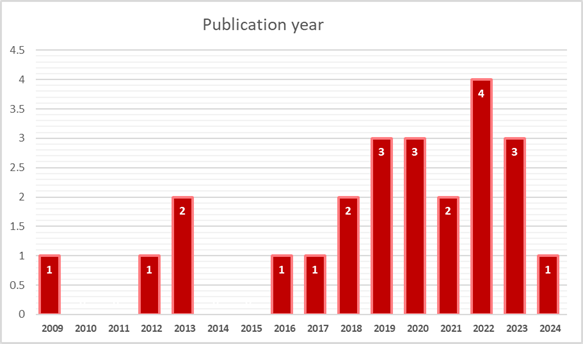
The research population consists of 24 articles published over a 15-year period (2009/1388–2024/1403). A chronological classification reveals that the highest number of studies (17%) were conducted in 2022/1401, while some years show no publications.
Figure 1. Classification of studies by publication year
3.1.2 Language of Studies
Among the selected studies, 5 were in English and 19 in Persian. While articles in other languages may exist on similar themes, they were not included in this sample.
Figure 2. Classification of studies by language
3.1.3 Research Approaches
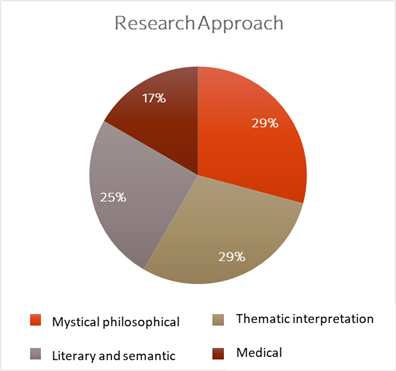
The studies adopt diverse methodological approaches: exegetical, philosophical-mystical, literary-semantic, and medical. The most prevalent approaches were exegetical and philosophical-mystical (29% each), while the least common was medical (17%).
Figure 3. Classification of studies by research approach
3.2 Analytical Findings
For the analytical phase, concepts from the sources were extracted, coded, and redundancies eliminated. Axial coding and categorization were performed, leading to the construction of qualitative themes. Four dimensional categories emerged, summarized in Table 2.
Table 2. Summary of Analytical Findings on the Heart and Its Dimensions in the Qur’an
Dimensional Categories
Qualitative Themes
Primary Concepts
Nature of the Heart
Spiritual/Metaphysical Dimension
• Heart as rūḥ (spirit) or rational soul (nafs-i nāṭiqa) • Heart as the true essence of humanity • Heart as the locus of divine names and intuitive knowledge • Heart representing humanity’s immaterial aspect
Pineal Organ
• Heart as a bodily organ • Heart as a physical entity • Heart as a muscular structure
Brain
• Heart as the third ventricle of the brain
Heart’s Relationships
Heart-Nafs (Self) Connection
• Identity of heart and nafs (= rūḥ) • Heart as the core of nafs • Heart as the adversary of nafs
Spiritual vs. Physical Heart
• Identity of spiritual and physical hearts • Heart as a multi-layered reality (material + spiritual) • Spiritual and physical hearts as distinct yet interacting entities
Heart-Brain/Neural Link
• Heart as the gateway to the brain’s “software” (mind) • Identity of heart and third brain ventricle • Heart as an independent neural network interacting with the brain via four channels: neural, biophysical, biochemical, and energetic
Functions of the Heart
Cognitive Functions
• Source cognition: Heart as the center of human perception • Instrumental cognition: Capacity for intuitive/revelatory knowledge • Heart as the processor of sensory cognition • Cardiac intelligence • Heart-brain
Emotional/Affective Functions
• Heart as the locus of emotions • Heart as the center of faith (īmān)
Volitional/Practical Functions
• Heart as possessing will and choice • Heart as the origin of desires • Heart as the driver of bodily actions
Heart’s Health
Sound Heart (Qalb-i Salīm)
• Semantics of qalb-i salīm (spiritual + physical health) • Traits of a sound heart: tranquility, faith, piety, stability, humility • Diseases of the heart
As shown in the table, the Qur’anic concept of the heart encompasses multidimensional aspects, including its nature, functions, health, and interrelations. Below, we explore these dimensions in detail to achieve a comprehensive understanding. The primary dimensions are:
3.2 Analytical Findings
3.2.1 The Nature of the Heart
The meta-synthesis of relevant studies reveals three primary perspectives on the nature of the heart in Islamic and Qur’anic thought:
A. The Heart as a Spiritual and Metaphysical Entity From this perspective, the heart in the Qur’an and the teachings of the Infallibles (AS) is understood metaphorically and through semantic extension (Vaezi & Jaddi, 2020, p. 251; Ahmadi & Haj Zain al-Abedini, 2012, p. 99; Kazemi Najafabadi, 2020, p. 9; Ghaemi Nia & Nasrati, 2018, p. 8). It represents a spiritual concept that, in mystical terms, manifests God’s comprehensive name and serves as the center for receiving intuitive and true knowledge.
In the Qur’anic view, the heart constitutes human identity, spirit, and the true inner personality hidden behind the outward appearance. The Qur’an presents the heart as the commander and representative of humanity’s immaterial dimension – possessing free will, serving as the center of human identity, and functioning as the rational soul that governs inner faculties (Baqerian Khozani, 2023, p. 69; Kiyanfar & Shokouhi Poor Alinameh, 2021, pp. 8-9; Ahmadi & Ghahremani, 2013, p. 153; Hosseini Karnami & Zakavi, 2019, p. 52; Ahmadi & Haj Zain al-Abedini, 2012, p. 104; Abdi, 2013, p. 2).
Proponents of this view argue against interpreting the Qur’anic heart as the physical organ because:
Physical heart transplantation doesn’t alter personality or spirituality (Waqar Raza, 2022, p. 186)
None of the Qur’anic attributes of the heart (e.g., hardening, having eyes/ears) apply to the physical organ (Ghaemi Nia & Nasrati, 2018, p. 9)
Hadiths identify the heart with intellect, which belongs to the spiritual realm (Ibid)
Qur’anic references to hearing, sight and heart don’t necessarily indicate physical functions (Ghaemi Nia & Nasrati, 2018, p. 9)
However, these scholars acknowledge a connection between the spiritual heart and physical heart, as the spirit connects to the body through the physical heart. Humans are bi-dimensional beings, and the heart represents a multi-layered reality encompassing both spiritual and material dimensions (Vaezi & Jaddi, 2020, p. 251).
B. The Heart as the Physical Pineal Organ Some exegetes interpret the Qur’anic heart literally as the pineal organ (Ma’ruf, 2009, p. 131; Oghba, Mehroosh & Mirani, 2018, p. 18), which contemporary science shows operates through a complex neural system, hormones, and electromagnetic fields (Ma’ruf, 2009, p. 131; Oghba, 2022, p. 16; Oghba, Mehroosh & Mirani, 2018, p. 18; Gillani & Ferdoos, 2022, p. 10). Their evidence includes:
The Qur’an mentions the heart alongside other sensory organs (Oghba, Mehroosh & Mirani, 2018, p. 18)
The heart’s functions in the Qur’anic worldview parallel modern understanding of brain functions (Ibid)
The heart processes sensory data and receives direct knowledge through revelation/inspiration (Ibid)
The Qur’an emphasizes the heart’s cognitive superiority over the brain (Gillani & Ferdoos, 2022, p. 10)
Relevant Prophetic traditions and Nahj al-Balagha references (Haque, 2017, p. 2; Ma’aref, Faghihizadeh & Rezaei, 2022, p. 31)
C. The Heart as the Brain This perspective identifies the Qur’anic heart with the brain’s third ventricle. Structural and functional similarities include:
The brain’s limbic system enclosure parallels the heart’s thoracic enclosure
The corpus callosum resembles the spinal column
The thalamic halves parallel the lungs
The third ventricle shares vital functions with the heart (Waqar Raza, 2022, pp. 205-209)
Thus, the physical brain may provide the physiological substrate for experiences attributed to the heart in the Qur’an, while the spiritual heart represents humanity’s transcendent aspects (Waqar Raza, 2022, pp. 205-209).
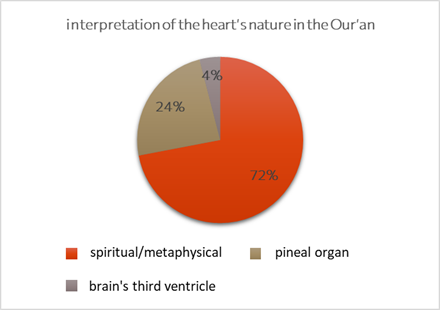
Meta-synthesis Results: 72% of studies viewed the Qur’anic heart as spiritual/metaphysical, while 28% interpreted it physically – with 24% referring to the pineal organ and 4% to the brain’s third ventricle.
Figure 4. Classification of studies by their interpretation of the heart’s nature in the Qur’an.
3.2.2 The Heart’s Relationships
Given differing views on the heart’s nature, its relationships with concepts like the self (nafs), pineal organ, and brain require examination.
3.2.2.1 Heart-Self (Nafs) Relationship Three main perspectives emerge:
Identity of Heart and Self/Spirit: Many exegetes equate the heart with the rational soul (nafs-i natiqa) and human spirit (Baqerian Khozani, 2023, p. 69; Kiyanfar & Shokouhi Poor Alinameh, 2021, pp. 8-9; Ahmadi & Ghahremani, 2013, p. 153; Hosseini Karnami & Zakavi, 2019, p. 52; Ahmadi & Haj Zain al-Abedini, 2012, p. 104; Salavati, 2023, p. 90; Abdi, 2013, p. 2).
Heart as the Essence of Self: Here, the self encompasses the whole human existence, while the heart represents its immaterial, commanding essence (Nurafshan & Khoshmanesh, 2021, p. 527).
Heart as the Self’s Adversary: This view distinguishes the soul (shared with animals) from the spirit (divine aspect). The heart and self coexist materially, with the self as a domestic enemy waiting to dominate the heart (Oghba, Mehroosh & Mirani, 2018, p. 23).
Therefore,
Heart and self concepts in the Qur’an are multilayered
The heart relates more to spiritual/cognitive aspects, while the self to material/animalistic dimensions
They interact continuously A comprehensive understanding requires integrating all perspectives.
3.2.2.2 Qur’anic Heart and Pineal Organ Relationship While some scholars identify them directly (Ma’ruf, 2009, p. 131; Oghba, 2022, p. 16; Oghba, Mehroosh & Mirani, 2018, p. 18; Gillani & Ferdoos, 2022, p. 10), integrative views propose:
A bi-dimensional reality (Vaezi & Jaddi, 2020, p. 252)
Two independent but interacting entities (Haque, 2017, p. 5)
The Qur’anic heart thus represents both a physical organ and spiritual center, requiring further research into their precise relationship.
3.2.2.3 Heart-Brain Relationship Three primary models emerge:
Heart as Information Gateway to Mind: The heart serves as input channel to the brain’s “software” (mind), with hearing and sight as additional inputs (Taherifar & Gharibzadeh, 2023, p. 61).
Identity with Third Ventricle: Structural/functional parallels suggest the heart refers to the brain’s third ventricle (Waqar Raza, 2022, p. 186).
Independent Neural System: The heart’s intrinsic nervous system allows independent information processing and four-channel communication with the brain (neural, biophysical, biochemical, energetic) (Haque, 2017, p. 5). Scientific evidence shows:
The heart sends more signals to the brain than vice versa
It possesses short/long-term memory capabilities
Neural outputs reach medulla, hypothalamus, thalamus, amygdala and cortex (Gillani & Ferdoos, 2022, p. 10)
Integrated Model: Combining these perspectives yields a comprehensive Qur’anic model where the heart functions as:
Physical blood pump
Information processing center
Emotional/intuitive hub
Gateway to mind This model accounts for both physiological and spiritual dimensions of heart-brain interaction.
3.2.3 Cardiac Health
Based on the meta-synthesis of source data, the concept of “qalb-e salim” (sound heart) in the Qur’an represents the most significant discussion of cardiac health. The findings can be examined through the following dimensions:
Semantics of the Sound Heart
From the maximalist perspective that equates the heart with human spirituality, the sound heart signifies pure spirit and healthy personality, where cardiac health equals spiritual well-being (Baqerian Khozani, 2023, p.69; Hosseini Karnami & Zakavi, 2019, p.53; Pourmohammadi & Sobhani Yamchi, 2021, p.38; Abdi, 2013, p.4).
The minimalist perspective, citing Prophetic traditions about the pineal heart’s role in physical health, interprets cardiac health physiologically (Oghba, 2022, p.35). Some scholars integrate both views, proposing that physical and spiritual cardiac health interact reciprocally – physical purification positively impacts spiritual state, and vice versa (Vaezi & Jaddi, 2020, p.253).
Characteristics of the Sound Heart
The meta-analysis identifies fourteen Qur’anic attributes of the sound heart: 1) Abrahamic (faithful), 2) Pious, 3) Gentle, 4) Receptive to advice, 5) Humble, 6) Repentant, 7) Awed by God’s remembrance, 8) Compassionate, 9) Modest, 10) Alive, 11) Mindful, 12) Tranquil, 13) Expansive, and 14) Pure from afflictions (Hosseini Karnami & Zakavi, 2019, p.50; Pourmohammadi & Sobhani Yamchi, 2019, p.50). Therefore, key conclusions are: a) The sound heart constitutes a unified whole encompassing spiritual, b) psychological and physical dimensions, c) These dimensions interact reciprocally, d) Spiritual health forms the foundation influencing other aspects, e) Physical health, particularly cardiac function, f) enhances spiritual wellbeing, and g) These characteristics manifest in behavior, speech and conduct.
3.2.4 Cardiac Functions
The meta-synthesis confirms consensus among researchers about the heart’s Qur’anic functions, though explanations vary according to their ontological perspectives:
Cognitive Function
The Qur’an presents the heart as a perceptual center that substitutes for intellect, termed “cardiac intellect” or “fu’ad” in Islamic mysticism and philosophy (Kiyanfar & Shokouhi Poor Alinameh, 2021, p.10; Salavati, 2023, p.98; Mehdipour & Dehghan Simkani, 2024, p.27; Jafari & Jafari, 2020, p.43). It operates through:
Cognitive Source: As the center of profound perception beyond ordinary sensory/intellectual comprehension (Ahmadi & Ghahremani, 2013, p.156; Abdi, 2013, p.3; Vaezi & Jaddi, 2020, p.239; Mehdipour & Dehghan Simkani, 2024, p.27; Taherifar & Gharibzadeh, 2023, p.61)
Cognitive Instrument: For minority views emphasizing the pineal organ, this involves the heart’s complex neural system (Gillani & Ferdoos, 2022, p.10; Haque, 2017, p.2; Oghba, Mehroosh & Mirani, 2018, p.18). Modern “cardiac intelligence” research shows: The heart’s intrinsic nervous system operates independently, It transmits more information to the brain than vice versa, and Intuition occurs through emotional/energetic connections and magnetic fields
Emotional Function
The heart’s multidimensional affective roles include:
From spiritual perspectives:
Center for spiritual emotions (awe, divine love, God-consciousness)
Receptor of spiritual inspirations
Regulator of spiritual-psychological states (Ahmadi, 2016, p.157; Ahmadi & Haj Zain al-Abedini, 2012, p.118)
Integrative views acknowledge interactions between spiritual and physical emotional processes (Vaezi & Jaddi, 2020, p.252)
Volitional Function
The heart’s operational roles in decision-making and behavior include:
From spiritual perspectives:
Origin of will and intention
Guide for actions
Source of moral motivation (Ahmadi & Ghahremani, 2013, p.158; Nurafshan & Khoshmanesh, 2021, p.544; Delbari, 2016, p.100)
From physiological perspectives:
Autonomous nervous system influences on voluntary/involuntary behaviors
Interactive heart-brain decision-making processes
This functional diversity underscores the heart’s Qur’anic significance across spiritual and scientific paradigms.
“This study demonstrates through meta-synthesis that the Qur’anic heart constitutes a multi-layered reality that simultaneously encompasses cognitive-emotional functions and maintains inseparable connections with both corporeal and spiritual human dimensions. The findings necessitate redefining the heart as a dynamic system where physical, psychological, and spiritual layers interact bidirectionally to shape human identity.”
4. Conclusion
The meta-synthesis of Qur’anic studies reveals that most existing research (72%) interprets the heart primarily as a spiritual and transcendent dimension of human existence, focusing on its cognitive, emotional, and volitional functions. However, a significant minority (28%) of studies have attempted to provide material and scientific explanations for the Qur’anic concept of cardiac function. A comprehensive understanding emerges when we consider the heart as a central nucleus that integrates all dimensions of human existence – both physical and spiritual. The health and development of this nucleus signifies human growth and perfection.
Key Findings:
Semantic Multilayeredness: The Qur’anic heart encompasses a spectrum of meanings from physical to metaphysical dimensions, reflecting its complexity in Islamic anthropology.
Anthropological Centrality: As the core of personality, willpower, faith, and divine connection, the heart serves as the pivotal center guiding human perfection.
Interconnected Systems: The heart operates within an integrated network involving spirit (rūḥ), self (nafs), brain, and other Qur’anic concepts.
Holistic Health: Cardiac health – both spiritual and physical – emerges as fundamental for human felicity and salvation.
Multifunctionality: Beyond cognition and emotion, the heart facilitates divine revelation and connection with the unseen world.
Research Gaps and Future Directions:
Our analysis identified critical lacunae in current research:
Neuroscientific Correlations: Insufficient exploration of cardiac functions vis-à-vis contemporary neuroscience.
Pineal Organ-Nonmaterial Interface: Limited studies on the interaction between the physical heart and its spiritual dimensions.
Recommended methodological approaches for future research include:
Exegetical-Philosophical Studies: Rigorous analysis of Qur’anic verses and hadiths concerning the heart.
Interdisciplinary Research: Integration of medical sciences and Qur’anic exegesis for holistic models.
Neurocognitive Investigations:
Mapping the heart’s intrinsic nervous system
Analyzing bidirectional heart-brain communication channels
Comparative study of cardiac vs. cerebral neurotransmitters
Psychological Experiments:
Empirical studies on cardiac vs. cerebral perception
Assessment of cardiac intelligence in cognitive processes
Impact of spiritual states on perceptual mechanisms
Integrative Models: Developing frameworks that synthesize spiritual and physiological dimensions of cardiac perception.
Qualitative Research:
Interviews with individuals having spiritual experiences
Content analysis of mystical texts for cardiac perception features
Comparative Studies: Cross-cultural examination of cardiac concepts in world religions and spiritual traditions.
Proposed Integrative Model:
We conceptualize the heart as a dynamic central nucleus surrounded by interacting layers:
Physical Layer: The pineal organ with its neural networks
Psychological Layer: Emotional and cognitive processing
Spiritual Layer: Divine connection and intuitive knowledge
These layers demonstrate reciprocal influence:
Physical health impacts spiritual-psychological states
Psychological states modulate both physical and spiritual dimensions
Complementary Perspectives:
Mystical View: Emphasizes the heart as the mirror of the soul
Philosophical View: Positions the heart as the center of cognition
Scientific View: Focuses on physiological mechanisms
References:
The Holy Qur’an.
Nahj al-Balagha.
Ibn Ashur, M. T. (2000). Al-Tahrir wa al-Tanwir. Beirut: Mu’assasat al-Tarikh.
Ahmadi, F., & Ghahremani, S. (2013). The Position and Role of the Heart in Mystical Ethics. Ethical Research, *4*(12), 147-169.
Ahmadi, M. N., & Haj Zain al-Abedini, A. (2012). The Mystery of the Word “Heart” in the Qur’an (Reality or Metaphor). Scientific Journal of the Iranian Association of Arabic Language and Literature, *8*(22), 99-120.
Baqerian Khozani, M. (2023). Functional Diseases of the Heart from the Qur’anic Perspective. Ma’rifat, *309*, 67-74.
Pourmohammadi, S. R., & Sobhani Yamchi, M. (2019). The Impact of Passive Reactions of the Sound Heart on Mental Health from the Qur’anic Perspective. Qur’anic Studies, *12*(46), 35-66.
Hosseini Karnami, S. H., & Zakavi, A. A. (2019). An Analysis of the Semantics of the Sound Heart: An Approach to Understanding Spiritual Health in the Qur’an. Religion and Health, *7*(1), 49-62.
Delbari, M. (2016). Educational Implications of the Semantics of the Heart in the Qur’an. Research Journal of Qur’anic Interpretation and Language, *5*(1), 81-106. https://doi.org/10.30473/quran.2016.3417
Raghib Isfahani, H. b. M. (1992). Mufradat Alfaz al-Qur’an. Beirut: Dar al-Shamiyya.
Rida, M. R. (1994). Tafsir al-Manar. Beirut: Dar al-Ma’rifa.
Saduq, M. b. A. (1989). Al-Khisal. Qom: Jami’at al-Mudarrisin.
Salavati, A. (2023). The Inner Capacities of the Heart for a Phenomenological Approach with Emphasis on Ibn Arabi’s Mystical School. Ontological Research, *12*(23), 85-109. http://doi.org/10.22061/orj.2023.1907
Tabatabai, M. H. (1973). Al-Mizan fi Tafsir al-Qur’an. Beirut: Al-A’lami Foundation.
Tabarsi, F. b. H. (1988). Majma’ al-Bayan. Beirut: Dar al-Ma’rifa.
Abedi Jafari, A., & Amiri, M. (2019). Meta-Synthesis: A Method for Synthesizing Qualitative Studies. Methodology of Humanities, *25*(99), 73-87. https://doi.org/10.30471/mssh.2019.1629
Abd al-Baqi, M. F. (1985). Al-Mu’jam al-Mufahras li Alfaz al-Qur’an al-Karim. Tehran: Islamic Publications.
Abdi, H. (2013). The Epistemological Position of the Heart in the Qur’an. In Qur’an and Epistemology. Tehran: Islamic Research Institute for Culture and Thought.
Oghba, B., Mehroosh, F., & Mirani, A. (2018). The Function of the Heart in the Qur’an. Qur’anic Studies and Islamic Culture, *2*(4), 25-45.
Oghba, B., & Mehroosh, F. (2019). Genealogy of the Qur’anic Concept of the Heart. Research Journal of Qur’anic Interpretation and Language, *7*(2), 77-94.
Oghba, B. (2022). Hakim Tirmidhi’s Interpretation of the Qur’anic Concept of the Heart. Critical Interpretive Views, *3*(2), 11-40.
Ghaemi Nia, A., & Nasrati, S. (2018). Cognitive Analysis of the Nature of the Heart in the Qur’an. Mind, *21*(84), 5-40.
Kazemi Najafabadi, S. (2020). Analysis of Ontological Metaphors in the Conceptual Domain of the Heart in Nahj al-Balagha. Nahj al-Balagha Studies, *8*(32), 1-19. http://doi.org/10.22084/nahj.2020.22327.2519
Kiyanfar, M., & Shokouhi Poor Alinameh, M. (2021). An Epistemological Study of the Wisdom of the Heart from Ibn Arabi’s Perspective Based on the Chapter of Shu’ayb. Hikmat Isra, *13*(1), 5-31.
Mishkini, A. (2003). Tahrir al-Mawa’iz al-‘Adadiyya. Qom: Al-Hadi.
Mustafawi, H. (1989). Al-Tahqiq fi Kalimat al-Qur’an al-Karim. Tehran: Ministry of Culture and Islamic Guidance.
Ma’aref, M., Faghihizadeh, A., & Rezaei, H. (2022). Cardiac Intellect in the Qur’an: Reality or Medical Misconception? Qur’an and Medicine, *7*(2), 30-37.
Ma’ruf, Y. (2009). The Heart in the Qur’an and Arabic Literature: Reality or Metaphor? Scientific Journal of the Iranian Association of Arabic Language and Literature, *5*(13), 129-154.
Nurafshan, M., & Khoshmanesh, A. (2021). Analysis of the Immaterial Dimension of Humans in the Qur’an Based on the Semantics and Reinterpretation of Nafs, Ruh and Qalb. Qur’an and Hadith Research, *54*(2), 527-547.
Vaezi, M., & Jaddi, H. (2020). Cognitive Dimensions of the Heart in the Qur’anic Epistemological System. Qur’an and Hadith Research, *53*(1), 239-257. http://doi.org/10.22059/jqst.2020.297452.669473
31.Armour, Andrew J. (1991). Intrinsic Cardiac Neurons, Journal of Cardiovascular Electrophysiology, 2 (4), 331- 341.
32.Gillani, Iram; Ferdoos, Amber. (2022). Heart Intelligence from Quran and Science: An Integrated Approach for the Evolution of Enlightened Self in the Society. International Research Journal on Islamic Studies (IRJIS), 4 (1), 1- 17.
33.Haque, Amber. (2017). The Concept of Heart in Islam and its Relevance to Islamic Psychology. Center for Study and Research New Delhi, India.
34.Jafari, Samaneh; Jafari, Tayyebe. (2020). A comparative study of the Eye of the Heart in Islamic Sufism and the Third Eye in Yoga. Journal of Literary Arts, 12 (2), 83- 92.
35.Sandelowski, Margarete; Barroso, Julie (2007). Handbook for synthesizing qualitative research. New York: Springer.
36.Sandelowski. (2008). Reading, writing and systematic review, Journal of advanced nursing, (64) 1, 104- 110. https://doi.org/10.1111/j.1365-2648.2008.04813.x.
37.Taheri Far, Leila; Gharibzadeh, Shahriar. (2023). Analysis of the Conceptual Map of Consciousness as a Cognitive Function in the Qur’an. Journal of Interdisciplinary Qur’anic Studies, 2 (1), 34- 66. http://doi.org. 10.37264/jiqs.v2i1june2023.3.
38.Waqar Raza, Muhammad. (2022). Anatomy of the Intellect in the Quran: A Fresh Perspective. Al-Bayān – Journal of Qurʾān and Ḥadīth Studies, V. 20, 182–216.