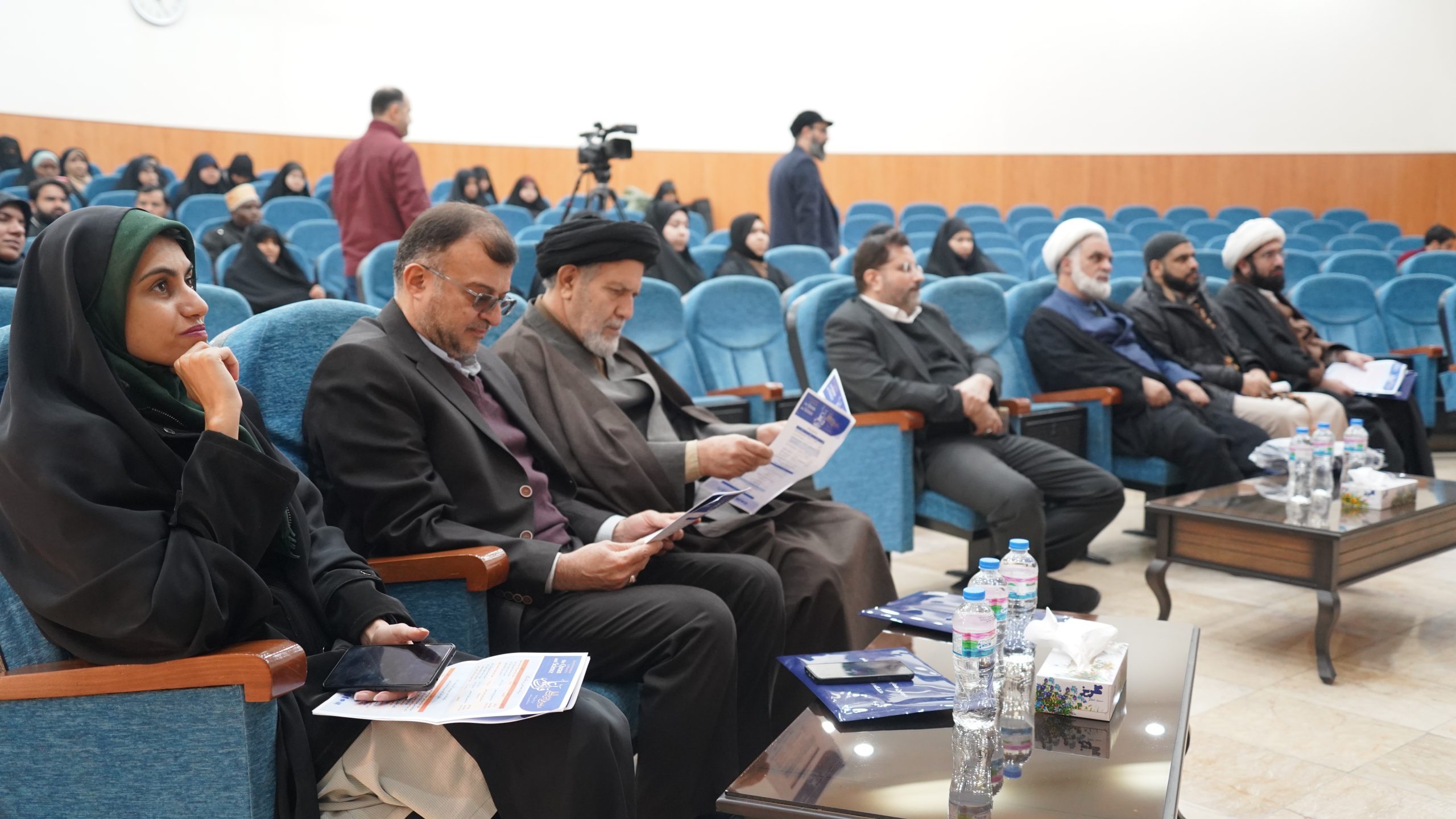
The inaugural session of the Second International Conference on Quran and Science featured five significant papers presented by eminent scholars from Iranian universities. Each paper, employing theoretical, critical, or methodological approaches, examined the relationship between science, humanity, reality, and the Quran. While offering diverse perspectives on the connection between science and revelatory knowledge, these papers shared common ground: dissatisfaction with the epistemological limitations of modernity, critique of autonomous rationality’s dominance, and efforts to reconsider the philosophical foundations of science through Quranic concepts.
Jamileh Sadat Alamolhoda adopted a philosophical lens to address “subjectivity” in the modern world – an experience she argued has led humans to seek control and ownership over all phenomena, even transcendental concepts like justice and compassion. She identified this objectification tendency as the root of serious deviations in modern rationality, proposing “Islamic realism” as the solution – an ontological realism aligned with Quranic concepts of cosmic order, universal human intuitions, and natural observation. Only through reconstructing rationality on Quranic foundations, she contended, can we find solutions to contemporary civilization’s ethical and social crises.
Rasoul Rasoulipour, from a theological perspective, addressed one of philosophy of religion’s most complex issues: “Divine Action.” Introducing the international DAP project (a collaboration between the Vatican and Western theology centers), he demonstrated how Western scholars are attempting to defend the concept of divine will in the world using modern scientific theories like quantum mechanics. While critiquing this movement, he emphasized the need for rational and ethical engagement with both “Divine Action” and “Divine Justice.”
Mohammad Fanaei Eshkevari, in a philosophical-theological paper, rejected essentialist opposition between science and religion, distinguishing between religious and human knowledge. He showed that apparent conflicts primarily stem from specific philosophical interpretations of scientific data rather than science itself. Many such conflicts, he argued, can be resolved through more precise epistemological examination, advocating for rational dialogue between science and religion when conducted without oversimplification or philosophical extremism.
Mohammad Hossein Namjoo, drawing on contemporary cosmology including multiverse theory, critiqued positivism and radical empiricism. Using scientific approaches, he demonstrated that science itself has moved beyond strictly sensory-based, deterministic views, now accommodating concepts beyond sensory proof. This openness in scientific horizons, he suggested, creates opportunities to reconsider questions of God and divine beliefs, with multiverse theory potentially serving as an argument against positivism.
Finally, Abdolhamid Vasati, employing methodological insights, advocated for network approaches in Quranic understanding. Presenting a systems logic-based model, he argued that developing comprehensive Quranically-grounded theories requires moving beyond isolated propositions. He introduced concepts like ontology, conceptual relations, and AI capabilities as tools for reconstructing the Quran’s conceptual map, applying this framework to analyze the verse “That is the Book…”
Collectively, these five papers represent an emerging trend in interdisciplinary Quran-science studies that moves beyond generic slogans about “religious science” or “connecting science and religion.” Through precise questioning, philosophical reconsiderations, and innovative methodologies, they open new horizons for investigating the relationships between science, reason, reality, and revelation. The authors – from Shahid Beheshti University, Kharazmi University, Institute for Research in Fundamental Sciences, Imam Khomeini Education and Research Institute, and Islamic Culture and Thought Research Center – reflect the diversity of perspectives and theoretical depth characterizing Iran’s academic dialogue on science and the Quran.