The Quran has consistently invited us to contemplate signs in nature – signs that may appear simple at first glance yet conceal profound meanings. One such instance is the reference to the raven in Verse 31 of Surah Al-Ma’idah. This verse describes a bird searching the earth, demonstrating a behavior that captures human attention and reveals previously overlooked insights:
“Then Allah sent a raven searching in the ground to show him how to conceal the disgrace of his brother. He said, ‘O woe to me! Have I failed to be like this raven and conceal the disgrace of my brother?’ So he became of the regretful.”
What stands out in this verse is the phrase “yabḥathu fil-arḍ” (searching the earth), rather than “burying.” This lexical choice directs our attention to behavior that aligns remarkably with the cognitive characteristics of corvids.
Modern scientific research has revealed that corvids possess advanced spatial memory, future planning capabilities, and complex problem-solving skills. They can mentally map hundreds of storage locations and retrieve their hidden resources months later without external cues. More remarkably, they sometimes relocate their caches to prevent theft by other birds, occasionally even feigning burial in one location while hiding their prize elsewhere. Such behavior requires sophisticated environmental understanding and awareness of competitors’ intentions – cognitive abilities once believed exclusive to primates.
From the Quranic perspective, the human observer doesn’t merely draw inspiration from the raven’s actions but experiences awe at recognizing unexpected intelligence in this small creature. The raven demonstrates memory storage, mental mapping of retrieval routes, and even deceptive behaviors to protect resources – cognitive functions now studied in biological cognition research that place corvids among the world’s most intelligent birds.
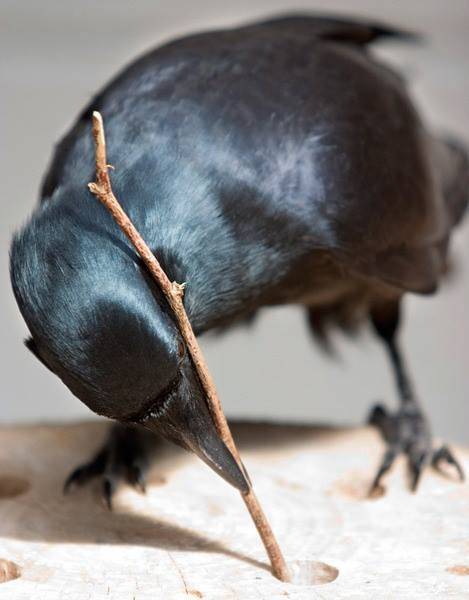
Studies show these birds perform comparably to seven-year-old humans in cognitive tests, demonstrating future visualization, tool-making, and multi-stage problem-solving abilities. Given this, when the Quranic verse depicts the raven engaged in behavior requiring strong memory and information processing, might this indicate recognition of the species’ cognitive complexity?
This inquiry opens new research pathways: If corvids’ exceptional memory enables past recollection and future planning, could this illuminate memory’s role in creative thinking and problem-solving across species? Might comparative studies reveal how memory influences decision-making and environmental adaptation? More significantly, could these traits inspire improvements in artificial intelligence and machine learning algorithms?
Contemplating this verse leads us to deeper understanding of cognition, planning, and environmental awareness in living beings. The human observer doesn’t merely learn a technique but encounters unexpected intelligence that challenges assumptions. This raises a crucial consideration: If the Quran highlighted corvid cognition over fourteen centuries ago, what other scientific insights might this text contain awaiting discovery?