Objective of This Call:
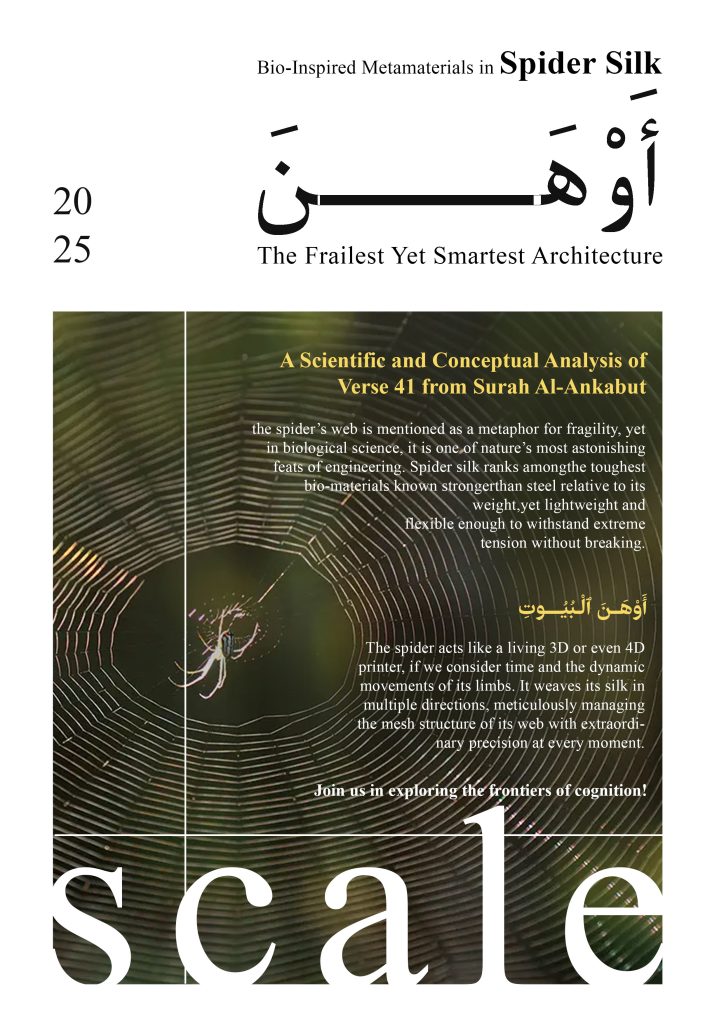
While the spider’s web is constructed from one of nature’s strongest biological materials, the Quran describes it as “the frailest of houses.” This apparent paradox invites scientific investigation into the properties of spider silk, the architecture of its web, and the profound scientific and cognitive message behind this remarkable creature. This research initiative invites students, researchers, and scholars to explore this complex structure from multiple perspectives—including biology, engineering, materials science, and emerging technologies.
These research projects will be conducted at various levels through schools, research centers, universities, and academic institutions. The suggested categories are flexible, and participants may contribute based on their interests and expertise. We welcome all forms of scientific, artistic, and literary contributions aligned with the participant’s academic level.
Level 1: Elementary Students | Introduction to the World of Spiders and Their Webs
Suggested Activities:
- Poster Design: How are different types of spider webs constructed?
- Storytelling & Creative Writing: If you were a spider, how would you build your home?
- Observation & Videography: Document spider behavior during web construction.
- 3D Models & Artwork: Create an artistic representation of a spider’s web using handmade crafts.
Basic Research Questions:
- Do all spiders build webs?
- Why do some spiders produce sticky silk while others do not?
- What materials stick to spider silk, and what do not?
Goal: Cultivate initial interest in spiders and introduce fundamental concepts of bioengineering.
Level 2: Middle & High School Students | Scientific Analysis of the Spider’s Web
Suggested Projects:
- Construct physical models of spider webs and analyze their structural properties.
- Strength vs. Fragility Paradox: Why is spider silk strong, yet the web itself is fragile?
- Comparative Web Structures: Do all spiders weave the same type of web?
- Hunting vs. Weaving Spiders: Behavioral differences between web-building and hunting spiders.
- Ballooning Phenomenon: Why do some spiders use silk for flight (ballooning) while others use it for trapping prey?
- Environmental Impact: How do humidity, temperature, and wind affect web stability?
Goal: Mechanical and biological analysis of spider webs, exploring adaptive behaviors.
Level 3: Undergraduate Students | Architecture and Physics of Spider Silk
Suggested Research Topics:
- Structural Variations: Comparative analysis of different spider silk types.
- Bio-Inspired Materials: How can spider silk inspire ultra-resistant synthetic materials?
- Acoustic & Vibrational Properties: Do spiders use web vibrations to detect prey?
- “Information Symphony”: How do spiders interpret environmental data through silk vibrations?
- Kinematic Simulation: Modeling spider movement during web construction and balance maintenance.
- AI Algorithm Optimization: Can spider decision-making in web-building improve machine learning models?
Goal: Investigate web architecture through biological, mechanical, and cognitive approaches.
Level 4: Graduate Students (MSc & PhD) | Biological Structure & Technological Applications of Spider Silk
Suggested Research Areas:
- Bio-Metamaterial Properties: Analyzing spider silk as a natural metamaterial.
- Computational Simulations: Predicting force distribution in spider web networks.
- Ultra-Sensitive Sensors: Developing accelerometers and vibration sensors inspired by silk.
- Molecular Structure & Silk Recycling: How do spiders recycle their own silk?
- Ballooning Mechanism: Bio-inspired applications in aerial robotics and material science.
- Biomedical Innovations: Silk-based bulletproof textiles, biodegradable sutures, and medical implants.
Goal: Advanced scientific study of spider silk and its potential in cutting-edge technologies.
Level 5: Interdisciplinary Researchers (Cognitive Science, Materials Engineering, Physics, Biology, AI)
Suggested Research Directions:
- AI & Decision-Making Models: Algorithm development based on spider web-adjustment strategies.
- Cognitive-Vibrational Interaction: How does a spider’s nervous system process web vibrations?
- Nanomaterial Modeling: Structural replication of silk at the nanoscale.
- Artificial Silk Production: Biomimetic approaches to synthetic silk manufacturing.
- 4D Printing Technology: Applying silk-spinning mechanisms to programmable materials.
- Bio-Sensors & Seismic Detection: Silk-inspired vibration sensors for environmental monitoring.
Goal: Exploring spider silk’s role in advanced technologies and cognitive modeling.
Submission Guidelines & Participation
- Participants at all levels may submit findings in the form of research papers, posters, videos, stories, or other creative formats.
- Outstanding contributions will be published on the project’s official website, with awards for top research.
- There are no restrictions on presentation methods—scientific, artistic, and literary submissions are equally encouraged.
- All research, ideas, and creative works must be submitted through the project’s official portal.
We look forward to your innovative contributions!